What Hotels and Hospitality Facilities in Chicagoland Actually Require from a Commercial Cleaning Program
What do hotels and hospitality facilities in Chicagoland actually require from a commercial cleaning program? Hotels and hospitality facilities in Chicagoland require cleaning programs that operate seven days a week across multiple distinct environments within the same property, including guest rooms, lobbies, restaurants, event spaces, rooftop areas, and back-of-house staff zones, each with different surface types, usage patterns, and sanitation standards. A standard commercial janitorial contract applied to a hospitality environment produces visible service failures within days because the program was never designed for an operation where cleanliness is not a facility standard. It is the product the guest is paying for.
Keep Your Facility Clean, Safe, and Inspection-Ready
Get professional cleaning services tailored to your building.
Why Hospitality Cleaning Is a Different Category from Commercial Office Cleaning
Commercial office cleaning programs are built around a predictable occupancy pattern: employees arrive in the morning, occupy the building during business hours, and leave in the evening. The cleaning crew arrives after hours, services the building, and leaves before the next day begins. This model works for office environments because the building is unoccupied during the cleaning window and the surfaces being cleaned are relatively uniform.
Hotels and hospitality facilities do not operate on this model. A hotel is occupied continuously, twenty-four hours a day, seven days a week. Guests check in and out at all hours. Restaurants open for breakfast, lunch, dinner, and late-night service. Event spaces transition between setups multiple times in a single day. Rooftop areas, bars, and lounges serve guests through evening and overnight hours. The cleaning program has to fit into an operation that never stops, not around one that pauses overnight.
The surfaces being cleaned in a hospitality environment are also categorically different from a commercial office. Guest rooms require a full-service cleaning protocol between occupancies that covers bedding, bathroom fixtures, high-touch surfaces, floors, and amenity restocking. Restaurant dining areas require sanitation between service periods that meets food safety standards, not general commercial cleaning assumptions. Event spaces require rapid turnover cleaning between setups under time pressure that no nightly cleaning program can address.
What a Seven-Day Hospitality Cleaning Program Actually Covers
A properly scoped cleaning program for a hotel or hospitality facility in Chicagoland is not a single program. It is a coordinated set of programs for each distinct environment within the property, scheduled around the operational calendar of the facility rather than around the preferences of the cleaning vendor.
Guest room cleaning covers full-service turnover between occupancies and daily refresh service for extended stays, including bathroom disinfection, high-touch surface cleaning, floor maintenance, and amenity restocking on a schedule that aligns with checkout times and housekeeping workflow.
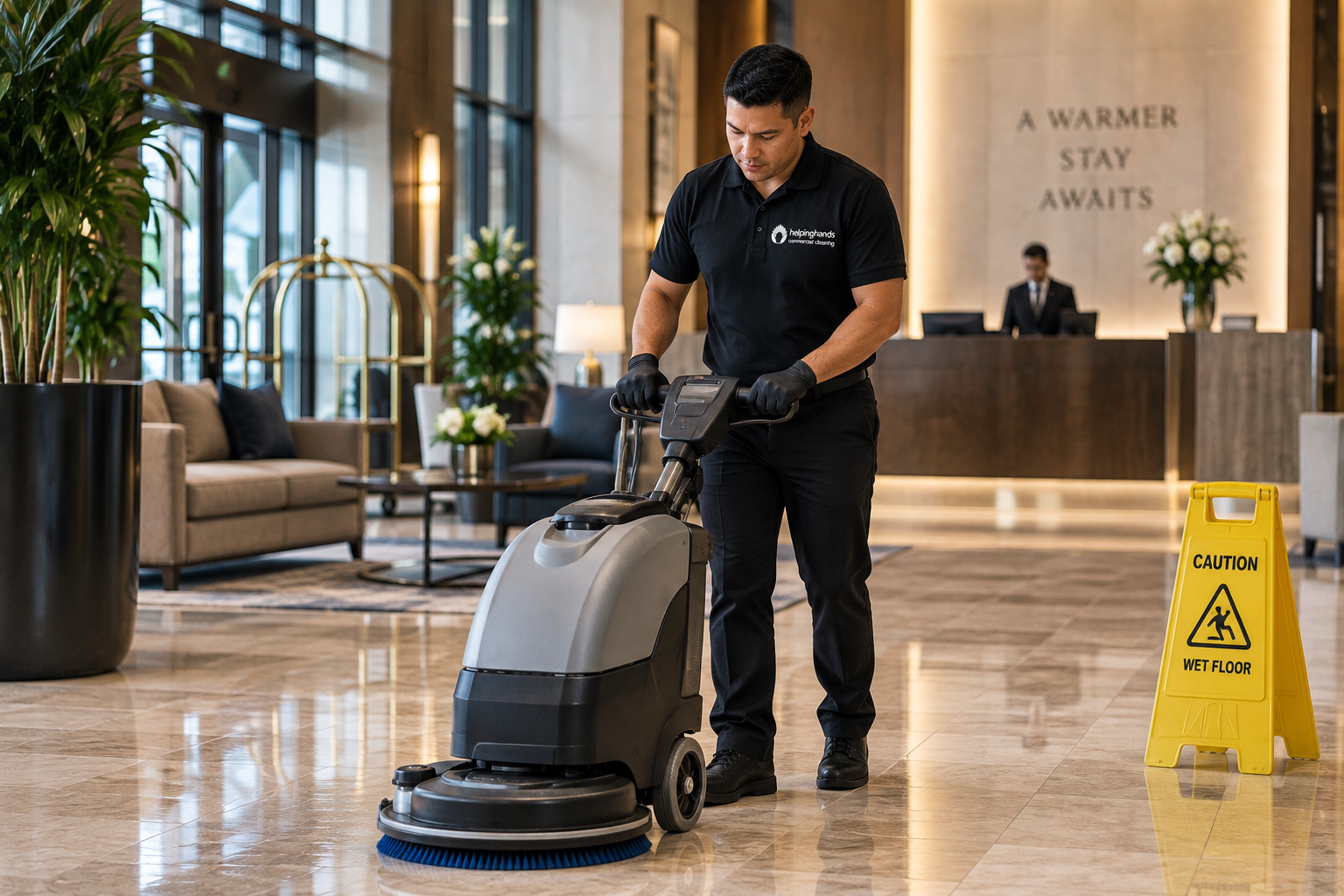
Lobby and common area maintenance requires continuous attention during operating hours rather than a single nightly cleaning cycle. A hotel lobby that sees hundreds of guests, visitors, and staff moving through it throughout the day cannot be maintained exclusively by a crew that arrives after midnight. Daytime porter coverage is the standard for any hospitality facility operating at meaningful occupancy levels.
Restaurant and food service areas within a hotel require cleaning protocols that address food residue, surface contamination, and floor maintenance between service periods. The sanitation standard in a hotel restaurant is governed by the same food safety framework that applies to standalone restaurant environments, not by general commercial cleaning assumptions.
Event spaces, rooftop areas, and specialty venues within a hospitality property require cleaning and setup support that responds to the event calendar of the property. A rooftop lounge that transitions from a private event to general service requires cleaning between uses, not at the end of the day.
Back-of-house areas including staff break rooms, service corridors, laundry facilities, and kitchen support areas require their own cleaning scope separate from the guest-facing program.
Why Direct-Hire Employees Matter in Hospitality Environments
Hotels and hospitality facilities cannot afford unknown personnel rotating through guest areas, back-of-house zones, and food service environments. The security implications of unvetted subcontractor crews in a property where guest rooms, storage areas, and restaurant facilities are all accessible to cleaning staff are not abstract. They are a direct operational and liability risk.
Direct-hire cleaning employees are background-checked before their first day, trained on the specific protocols of each area of the property, and accountable to a local management team with a named point of contact. In a hospitality environment where the guest experience is the product, the professionalism, consistency, and accountability of the cleaning staff is not a secondary consideration. It is a component of the brand standard the property is responsible for maintaining.
Crew consistency in a hotel environment also produces operational efficiency that rotating subcontractor crews cannot match. A team that knows the property, knows the guest room layout, knows the restaurant service schedule, and knows the event calendar cleans faster, makes fewer errors, and requires less supervision than a crew encountering the property for the first time on any given shift.
What Weekly Inspections Mean for Hospitality Properties
Hotel general managers and property directors responsible for hospitality facilities in Chicagoland need a cleaning vendor that produces documentation alongside the cleaning itself. Weekly supervisor inspections with photo documentation create a performance record that protects the property director when a guest complaint references a cleanliness issue, provides a baseline for performance conversations with the cleaning vendor, and gives property management visibility into the condition of the facility on a continuous basis.
A hospitality property that can demonstrate a consistent, documented cleaning program is in a fundamentally stronger position during brand audits, franchise compliance reviews, and health department inspections than one relying on verbal assurances from the cleaning vendor.
Helping Hands Commercial Cleaning: Serving Hospitality Facilities Across Chicagoland Since 2001
Helping Hands Commercial Cleaning is a woman-owned commercial janitorial company headquartered in Elmhurst, Illinois, serving DuPage, Cook, Kane, Will, and Lake Counties since 2001. The company employs direct-hire employees exclusively, holds GBAC certification for infection-control protocols, and conducts weekly supervisor inspections with photo documentation on every account.
For hotels, restaurants, event venues, and hospitality facilities across Chicagoland, Helping Hands offers on-site walkthroughs to assess the specific cleaning scope, operational schedule, and compliance requirements of each property before building a program.
To schedule a walkthrough, contact Helping Hands Commercial Cleaning at Call (630) 530-8121.