
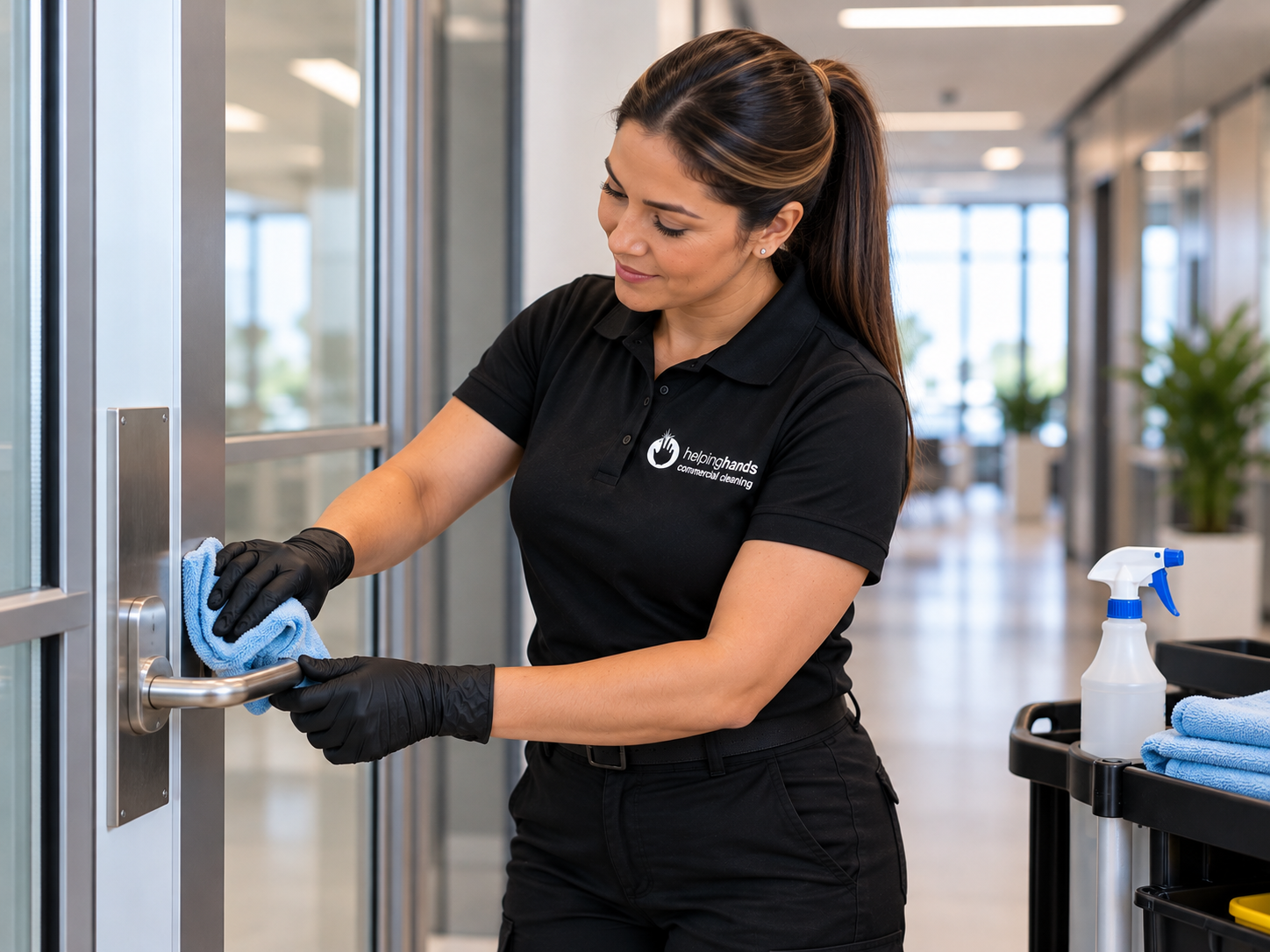
What is the difference between cleaning, sanitizing, and disinfecting? Cleaning removes dirt, germs, and impurities from a surface. Sanitizing reduces germs to a level considered safe by public health standards. Disinfecting kills most germs on a surface using an EPA-registered product. They are not interchangeable, and when you hire commercial disinfecting services in Chicago, knowing which one you are paying for matters. Helping Hands Commercial Cleaning has served Chicagoland since 2001, and this guide explains each level so facility managers can ask the right questions.
Keep Your Facility Clean, Safe, and Inspection-Ready
Get professional cleaning services tailored to your building.
The Three Terms, Defined
The CDC and EPA draw clear lines between the three, and the difference is the goal of each step.
Cleaning | Sanitizing | Disinfecting | |
|---|---|---|---|
What it does | Removes dirt, germs, and impurities | Reduces germs to levels public health codes consider safe | Kills most germs on surfaces and objects |
Typical tools | Soap or detergent, water, scrubbing | EPA-registered sanitizing products | EPA-registered disinfecting products |
Clean first? | Not applicable | Yes | Yes |
Label contact time | Not applicable | Check the label | Surface must stay wet for the full time |
Cleaning
Sanitizing
Disinfecting
What it does
Removes dirt, germs, and impurities
Reduces germs to levels public health codes consider safe
Kills most germs on surfaces and objects
Typical tools
Soap or detergent, water, scrubbing
EPA-registered sanitizing products
EPA-registered disinfecting products
Clean first?
Not applicable
Yes
Yes
Label contact time
Not applicable
Check the label
Surface must stay wet for the full time
For the full definitions, see the CDC’s cleaning and disinfecting guidance and the EPA’s explanation of the difference between products that disinfect, sanitize, and clean. The EPA also notes that disinfectants face more rigorous testing than sanitizers, and that many products are registered for both.
Why Cleaning Always Comes First
Sanitizing and disinfecting both assume the surface is already clean. The CDC advises cleaning a surface before sanitizing or disinfecting it, because dirt and residue stand between the product and the germs. A disinfectant sprayed on a dirty surface has less chance of doing its job.
That is why a good program treats cleaning as the foundation and disinfecting as an added step for the places that need it, rather than a replacement for cleaning.
Contact Time: The Step Most People Miss
A disinfectant does not work the moment it touches a surface. The label lists a contact time, which is how long the surface must stay wet. According to the EPA, you should pay close attention to it and follow the label directions. If the surface dries before the time is up, the product may need to be applied again.
In practice, this means spraying and wiping immediately is not disinfecting. It is only cleaning with an extra step that does little. Asking a vendor how they handle contact time is one of the most revealing questions you can ask.
Which Level Does Each Area of Your Facility Need?
This is general guidance. Your own regulations, health codes, and industry requirements decide the final answer.
Area | What it typically needs | Why |
|---|---|---|
Entrances, floors, general surfaces | Cleaning | The main goal is removing soil |
Restrooms, door handles, light switches, shared equipment | Cleaning, then disinfecting | Many people touch these surfaces |
Break room tables and counters | Cleaning, and sanitizing where food contact is involved | Check the label for food-contact use |
Healthcare, labs, and schools during illness | Cleaning, then disinfecting per the facility’s protocol | Higher risk of spreading illness |
Area
What it typically needs
Why
Entrances, floors, general surfaces
Cleaning
The main goal is removing soil
Restrooms, door handles, light switches, shared equipment
Cleaning, then disinfecting
Many people touch these surfaces
Break room tables and counters
Cleaning, and sanitizing where food contact is involved
Check the label for food-contact use
Healthcare, labs, and schools during illness
Cleaning, then disinfecting per the facility’s protocol
Higher risk of spreading illness
Restroom upkeep deserves its own plan, which we cover in our commercial restroom cleaning standards guide. For schools and medical offices during the colder months, see our post on preparing for flu season.
How Often Does Disinfecting Need to Happen?
There is no single schedule that fits every building. The CDC has noted that daily sanitizing may not be necessary when surfaces are cleaned carefully after use, so the answer depends on how a space is used. A few questions help set the right rhythm:
How many people touch the surface? A shared door handle at a busy entrance is a different case from a private office.
Is anyone in the building more vulnerable to illness? Schools, medical offices, and similar settings often call for a stricter protocol.
Has there been a reported illness or an outbreak? That is usually the moment to add targeted disinfecting on top of the regular routine.
Do your own regulations or your insurer require it? Your industry rules set the minimum, and your vendor should work to them.
How many people touch the surface? A shared door handle at a busy entrance is a different case from a private office.
Is anyone in the building more vulnerable to illness? Schools, medical offices, and similar settings often call for a stricter protocol.
Has there been a reported illness or an outbreak? That is usually the moment to add targeted disinfecting on top of the regular routine.
Do your own regulations or your insurer require it? Your industry rules set the minimum, and your vendor should work to them.
Putting these answers in writing with your vendor keeps everyone clear on what is cleaned every visit and what is disinfected on a set schedule or when a situation calls for it.
Common Mistakes
Skipping the cleaning step. Disinfecting a dirty surface is the most common error.
Wiping too soon. Without the full contact time, the product does not do its job.
Disinfecting everything. More chemicals is not better. Use disinfectant where it is needed.
Assuming “disinfected” means sterile. The EPA describes disinfectants as products that destroy or inactivate bacteria, fungi, and viruses, but not necessarily bacterial spores.
Ignoring the safety data sheet. Every product has one, and it covers safe use.
Skipping the cleaning step. Disinfecting a dirty surface is the most common error.
Wiping too soon. Without the full contact time, the product does not do its job.
Disinfecting everything. More chemicals is not better. Use disinfectant where it is needed.
Assuming “disinfected” means sterile. The EPA describes disinfectants as products that destroy or inactivate bacteria, fungi, and viruses, but not necessarily bacterial spores.
Ignoring the safety data sheet. Every product has one, and it covers safe use.
Questions to Ask Your Cleaning Vendor
Which areas do you clean, and which do you disinfect?
Are your disinfectants EPA-registered, and can I see the safety data sheets?
How do you handle contact time?
Are your technicians trained in infection-control protocols?
How is the work inspected, and do I get a record?
Which areas do you clean, and which do you disinfect?
Are your disinfectants EPA-registered, and can I see the safety data sheets?
How do you handle contact time?
Are your technicians trained in infection-control protocols?
How is the work inspected, and do I get a record?
How Helping Hands Commercial Cleaning Approaches It
Helping Hands Commercial Cleaning is GBAC certified for infection-control protocols and employs 100% W-2 trained, bonded, and insured staff, never subcontractors. Our programs include weekly quality control inspections and dedicated account management. You can read more about our healthcare and medical facility cleaning and how we serve facilities across DuPage, Cook, Kane, Will, and Lake Counties through our commercial cleaning services in Chicago.
To talk through what your facility needs, request a customized commercial cleaning quote or call (630) 530-8121.
Written by Gosia Baran, Founder of Helping Hands Commercial Cleaning.