The Hidden Financial Risks of Inadequate Warehouse Cleaning
By Helping Hands Commercial Cleaning
Keep Your Facility Clean, Safe, and Inspection-Ready
Get professional cleaning services tailored to your building.
For industrial cleaning standards Chicagoland warehouse, safety risks, compliance failures, and unplanned downtime outweigh any short-term savings from skipped cleaning cycles. Outsourced warehouse programs run $0.08 to $0.18 per square foot annually. Elmhurst-based Helping Hands Commercial Cleaning, with 120 employees, structures scope tiers precisely to prevent Chicagoland warehouses from absorbing far costlier emergency remediation later.
Cutting corners on Chicagoland warehouse cleaning costs far more than skipped invoices: soil buildup, floor damage, and OSHA violations follow. Industry data shows outsourced warehouse programs run $0.08 to $0.18 per square foot annually. Corner-cutting erases those savings through equipment downtime, contamination incidents, and costly emergency reversals that Helping Hands Commercial Cleaning’s inspection-driven protocols prevent.
Key Takeaways
Professional warehouse cleaning costs $0.08 to $0.18 per square foot annually in Chicagoland facilities.
Inadequate cleaning creates safety risks, compliance violations, and unexpected emergency cleaning expenses for warehouses.
Poor maintenance reduces operational efficiency and productivity in distribution centers and storage facilities significantly.
Helping Hands Commercial Cleaning’s 120-person team prevents costly corner-cutting through comprehensive industrial cleaning programs.
Professional warehouse cleaning costs $0.08 to $0.18 per square foot annually in Chicagoland facilities.
Inadequate cleaning creates safety risks, compliance violations, and unexpected emergency cleaning expenses for warehouses.
Poor maintenance reduces operational efficiency and productivity in distribution centers and storage facilities significantly.
Helping Hands Commercial Cleaning’s 120-person team prevents costly corner-cutting through comprehensive industrial cleaning programs.
What Does Cutting Corners Really Cost You?
Skipping proper cleaning scope on a warehouse or manufacturing floor creates cost exposure far beyond the invoice total. Plant managers who accept a stripped-down cleaning bid often absorb hidden expenses later, including unplanned repairs, downtime, and safety citations. That gap between quoted price and actual cost is the true cost of poor janitorial industrial Illinois operations pay for repeatedly.
Industrial cleaning is inherently more complex than typical office janitorial work. Dock areas, machinery, high racking, and heavy soil loads demand specialized equipment and trained crews, not a mop and a spray bottle. Facilities that scope cleaning like a standard office contract underestimate the labor, equipment, and compliance work required to meet real industrial cleaning standards Chicagoland warehouse operators need to pass audits and inspections.
Why Do Cleaning Bills Surprise Facility Managers?
Many operations leaders discover the real cleaning cost only after a project wraps or an inspection flags a violation. That final invoice, or that OSHA citation, catches managers off guard precisely because early budgeting skipped scope items like high-level dusting, floor degreasing, or dock sanitation.
What Gets Cut First — and What It Costs Later
Corners typically get cut in predictable places:
Reduced cleaning frequency on high-traffic aisles and loading zones
Skipped high dusting safety warehouse Illinois protocols on racking and overhead structures
Deferred floor degreasing until visible buildup creates slip hazards
Inconsistent documentation needed for warehouse cleaning safety compliance Illinois reviews
Reduced cleaning frequency on high-traffic aisles and loading zones
Skipped high dusting safety warehouse Illinois protocols on racking and overhead structures
Deferred floor degreasing until visible buildup creates slip hazards
Inconsistent documentation needed for warehouse cleaning safety compliance Illinois reviews
Each shortcut lowers the sticker price today and raises risk tomorrow. A trade most plant managers regret once the bill, or the citation, arrives.
What Do Industrial Cleaning Standards Actually Require?
Industrial cleaning standards Chicagoland warehouse operators depend on demand more than a mop and a checklist. Real compliance requires heavy-duty machinery, teams trained to work safely in high-risk zones, and strict adherence to legal safety codes. cite-1 Distribution centers and manufacturing plants across Chicagoland can’t treat cleaning as an afterthought; the scope and the risk are simply too large.
Full-scope programs cover far more ground than a typical office contract. Facility teams should expect coverage across:
Floors and aisles, including high-traffic forklift lanes
Shelving and storage racks
Machinery and equipment surfaces
Loading docks
Restrooms and break areas
Floors and aisles, including high-traffic forklift lanes
Shelving and storage racks
Machinery and equipment surfaces
Loading docks
Restrooms and break areas
This range of surfaces explains why generic cleaning falls short. Warehouse cleaning goes beyond basic wipe-downs. It demands specialized equipment and professionals trained specifically for industrial environments, not staff pulled from a standard office rotation.
Does an industrial site need daily cleaning to stay compliant?
Yes, in most active facilities. Legitimate industrial janitorial programs get built for high-traffic, multi-shift environments, and that reality drives a minimum service frequency of three to five days per week. Anything less lets soil load, dust, and debris accumulate faster than a lighter schedule can address, creating gaps in warehouse cleaning safety compliance Illinois teams are expected to maintain.
What separates industrial cleaning from routine office cleaning?
Scale and risk. Office cleaning rarely involves loading docks, machinery, or racking systems reaching into high-dust zones. Industrial sites require crews trained for elevated-risk work areas. Equipment built to handle heavier soil loads and larger square footage. Plant managers evaluating a provider should confirm the crew’s training record, not just its price sheet. Assuming a program meets facility-specific safety standards.
What Does Poor Janitorial Work Cost Illinois Facilities?
Poor janitorial work costs Illinois facilities remediation bills ranging from $15,000 for a small manufacturing plant to $100,000 or more for a large chemical processing site. cite-1 The gap between those two numbers reflects scope, contamination severity, and how long a facility ignored the problem before addressing it. Neglect compounds quietly, then arrives as one large invoice.
The cost of poor janitorial industrial Illinois facilities absorb rarely shows up as a single line item. It shows up as safety risk. It shows up as delayed production schedules. Underscoped cleaning programs create exposure well beyond added expense, including serious injury risk and frustrating project delays that ripple through multi-shift operations across Chicagoland’s warehouse corridors. cite-1
How should a plant manager budget for cleaning instead of reacting to it?
Budgeting starts with understanding that a per-square-foot rate is a unit price, not a total cost. Getting an accurate number means multiplying that rate by square footage, cleaning frequency, and scope tier. The same math that separates a $15,000 remediation from a $100,000 one. cite-2
Facility Type | Remediation Exposure |
|---|---|
Small manufacturing plant | Approximately $15,000 |
Large chemical facility | $100,000 or more |
Facility Type
Remediation Exposure
Small manufacturing plant
Approximately $15,000
Large chemical facility
$100,000 or more
What does a reactive cleaning approach actually put at risk?
A reactive approach puts more than housekeeping at stake. Ignoring routine service until conditions decline creates the exact conditions tied to serious safety risks and frustrating project delays. Facility managers across Chicagoland’s manufacturing and distribution hubs face this exposure most acutely during peak production cycles, when downtime carries the highest cost.
Recurring programs scoped correctly from the start — rather than emergency remediation after the fact — keep that exposure contained. Facilities serving Chicagoland’s industrial base benefit from providers who scope by square footage, frequency, and risk tier from day one, rather than waiting for a crisis invoice to force the conversation.
How Does Cleaning Tie To Safety Compliance?
Cleaning protects warehouse safety and regulatory standing at the same time. Facility cleanliness prevents slip hazards, blocked exits, and combustible dust buildup that trigger OSHA citations. Warehouse cleaning safety compliance Illinois programs treat sanitation as a compliance function, not a cosmetic task. Dirty floors and cluttered aisles create documented liability for plant managers.
For Chicagoland distribution centers and manufacturing plants, industrial cleaning standards Chicagoland warehouse operations depend on structure. Random cleaning schedules leave gaps that inspectors notice. Inspection-driven protocols catch problems before they become violations. Color-coded systems prevent cross-contamination between production zones, loading docks, and restroom areas. Safety Data Sheet compliance ensures every chemical used on-site meets documented handling. Storage requirements, a detail EHS managers cannot afford to overlook during an audit.
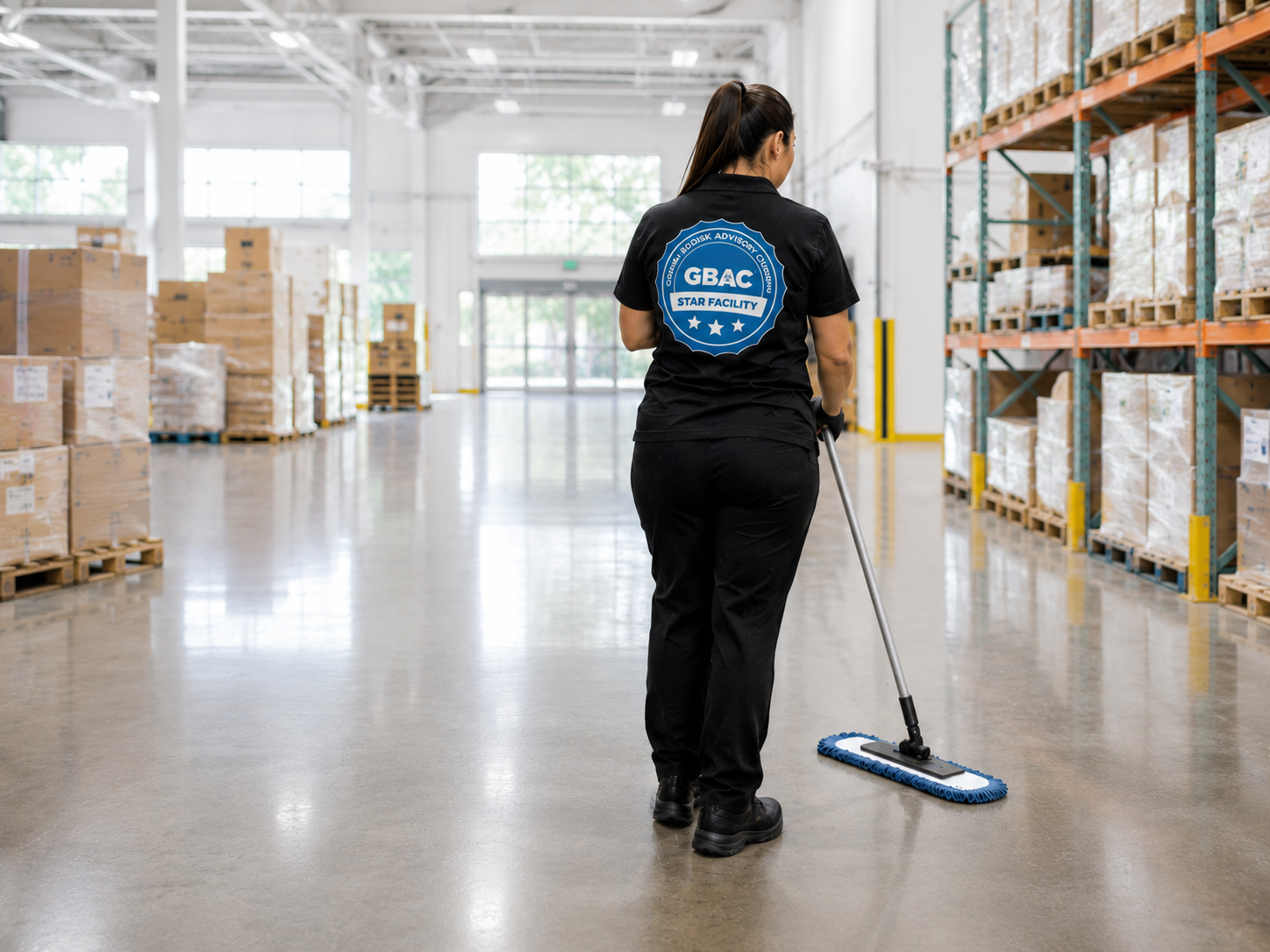
Certification backs up these protocols. GBAC STAR certification represents the cleaning industry’s highest health and safety standard. Paired with active ISSA and BSCAI membership, it signals a program built on verified science rather than guesswork.
What Does OSHA Expect From Warehouse Cleaning Programs?
OSHA cleaning standards industrial facility requirements focus on walkway clearance, dust control, and chemical labeling. Facilities that skip documented cleaning routines face higher citation risk during unannounced inspections. Structured protocols give plant managers a paper trail proving due diligence.
Why Does High Dusting Matter For Warehouse Safety?
High dusting safety warehouse Illinois work removes combustible particulate and debris from overhead beams, ductwork, and racking before it accumulates. Neglected high-dust zones contribute to fire risk and equipment contamination across Chicagoland industrial sites. Regular high dusting keeps overhead surfaces from becoming a hidden liability.
Cleanliness, in short, functions as a compliance record — not just an appearance standard.
What OSHA Cleaning Standards Apply To Facilities?
OSHA cleaning standards industrial facility requirements center on housekeeping, hazard communication, and walking-working surface rules that keep floors, aisles, and equipment areas free of slip, trip, and fire hazards. Large manufacturing and distribution operations across Chicagoland face inspection scrutiny on exactly these points. Facility managers who treat cleaning as cosmetic rather than compliance-driven expose their sites to citations, downtime, and worker injury claims.
Industrial sites carry heavier obligations than typical office buildings. Construction and manufacturing environments require specialized heavy-duty equipment, trained crews comfortable in high-risk zones, and strict adherence to legal safety standards. A baseline that mirrors OSHA’s housekeeping and hazard-communication expectations. Meeting industrial cleaning standards Chicagoland warehouse operators depend on means building programs around documented inspection routines, not spot-checks.
What does poor janitorial compliance actually cost a plant?
The cost of poor janitorial industrial Illinois facilities absorb shows up in fines, equipment downtime from dust buildup, and liability exposure when a preventable slip injures an employee. Weekly management inspections paired with photo-verified quality assurance documentation give operations leaders a compliance-ready audit trail instead of guesswork. That documentation matters directly during OSHA walkthroughs and insurance reviews alike.
Who should be cleaning a regulated industrial facility?
Warehouse cleaning safety compliance Illinois programs depend on accountable labor, not unvetted outside crews rotating through a site. A workforce of trained, background-checked employees supports consistent, compliant practices that facility managers can verify and trust. This staffing model reduces the risk gaps that come with inconsistent, poorly supervised labor pools.
Key compliance touchpoints plant managers track include:
Documented inspection frequency and photo evidence
High dusting safety warehouse Illinois protocols for overhead beams and racking
Verified, background-checked staffing over unvetted labor
Documented inspection frequency and photo evidence
High dusting safety warehouse Illinois protocols for overhead beams and racking
Verified, background-checked staffing over unvetted labor
Strong compliance documentation also strengthens industrial janitorial program ROI Chicago facilities can demonstrate to auditors and insurers.
What Does Industrial Cleaning Cost Per Square Foot?
Outsourced warehouse and distribution center programs across Chicagoland run $0. [cite-2](https://millfac.com/blog/warehouse-cleaning-cost-guide)08 to $0.18 per square foot annually. Light industrial and manufacturing environments typically land higher, between $0. cite-210 and $0.20 per square foot. Plant managers comparing bids should treat these ranges as a starting point, not a final number. The rate reflects only the unit price.
Four variables move a facility up or down within that range: soil load, floor complexity, shift count, and scope tier. cite-2 A single-shift facility with sealed concrete floors sits at the lower end. A three-shift manufacturing plant with heavy grease, metal shavings, or food-grade sanitation needs pushes toward the top. Understanding these drivers matters for anyone building industrial cleaning standards Chicagoland warehouse budgets around measurable inputs rather than guesswork.
How Should a Facility Calculate Its Actual Budget Number?
The per-square-foot figure is a unit price, not a total cost. Operations leaders multiply that rate by total square footage, cleaning frequency, and scope tier to reach an accurate annual figure. Skipping this step is the most common budgeting error EHS managers make when comparing vendor proposals.
Facility Type | Typical Rate per Sq Ft | Primary Cost Driver |
|---|---|---|
Distribution/warehouse | $0.08–$0.18 | Shift count, floor size |
Light industrial/manufacturing | $0.10–$0.20 | Soil load, floor complexity |
Facility Type
Typical Rate per Sq Ft
Primary Cost Driver
Distribution/warehouse
$0.08–$0.18
Shift count, floor size
Light industrial/manufacturing
$0.10–$0.20
Soil load, floor complexity
Why Does Scope Tier Change the Price So Much?
Scope tier determines what falls inside the contract versus what gets billed separately. Programs limited to floor care and restrooms sit at the base rate. Programs adding high dusting safety warehouse Illinois work, machinery detailing, or dock-area sanitation climb toward the upper end. Facilities with multi-shift operations also pay more, since round-the-clock coverage requires additional staffing hours built into the square-foot rate.
How Does High Dusting Protect Warehouse Safety?
High dusting safety warehouse Illinois protocols remove accumulated particulate from overhead beams, shelving, storage racks, and machinery before it becomes a hazard. Dust buildup on elevated surfaces creates fire fuel, contaminates product, and drops onto workers below without warning. Left unaddressed, that accumulation raises the cost of poor janitorial industrial Illinois facilities absorb through downtime, rework, and failed inspections.
Thorough warehouse cleaning covers far more than sweeping the floor. It extends to storage racks, machinery, equipment housings, and every elevated surface where dust settles unnoticed. Neglecting these zones invites the same particulate to migrate back down onto clean floors and product staging areas within days.
What Does High Dusting Actually Involve?
Elevated cleaning in a working warehouse demands specialized heavy-duty equipment and crews trained for high-risk zones. These teams work near conveyor lines, racking systems, and overhead machinery while maintaining strict compliance with legal safety standards. A crew lacking that training turns a routine dusting job into a fall or equipment-damage incident.
How Do Floor Programs Fit Into the Same Safety Plan?
Dust dislodged from overhead surfaces lands somewhere, and that somewhere is usually the floor. Coordinated floor care — burnishing, tile scrubbing, and carpet extraction. Clears residue before it turns into a slip-and-fall hazard in high-traffic aisles.
Industrial cleaning standards Chicagoland warehouse operations rely on inspection-driven protocols to catch dust hazards invisible from ground level. Color-coded cross-contamination prevention systems and Safety Data Sheet compliance keep elevated cleaning aligned with warehouse cleaning safety compliance Illinois requirements. Facilities pairing high dusting with floor programs reduce two hazards at once:
Overhead risk — dust, debris, and contaminants cleared from beams, racks, and machinery.
Ground-level risk — residue removed through scrubbing and burnishing before it reaches walkways.
Overhead risk — dust, debris, and contaminants cleared from beams, racks, and machinery.
Ground-level risk — residue removed through scrubbing and burnishing before it reaches walkways.
Plant managers reviewing OSHA cleaning standards industrial facility requirements should treat elevated surfaces. Floors as one connected safety program, not separate tasks.
What ROI Does A Real Janitorial Program Deliver?
Return on an industrial janitorial program ROI Chicago shows up as reduced downtime, contained costs, and documented accountability across warehouse and manufacturing facilities throughout the region. Plant managers who track spend against safety incidents, floor damage, and audit outcomes see the pattern quickly: cleaning quality and operational risk move together, not separately.
The cost of poor janitorial industrial Illinois facilities absorb rarely appears on a single invoice. It shows up in slip-and-fall claims, failed audits, damaged flooring, and rushed corrective cleaning after an inspector flags a violation. A scoped program prevents that surprise entirely.
How Does A Walkthrough Protect The Budget?
A proposal built on-site, rather than a apartment generic rate, keeps facility budgets accurate from day one. Engagements begin with a walkthrough of the actual floor plan, traffic patterns, and soil load, followed by a scoped proposal matched to that specific facility. That process eliminates the guesswork that leads to mid-contract change orders.
Does Contract Flexibility Actually Improve ROI?
Yes, flexibility protects ROI more than a locked-in term does. Recurring plans without long-term contracts let operations leaders adjust scope as production volume shifts. 24/7/365 availability across the service area keeps crews accessible for off-shift cleaning or emergency response.
Additional ROI drivers include:
Accountability tied to results: a a notable share satisfaction guarantee on select service pages links program performance directly to measurable outcomes, not vague promises.
Operational reliability: a structured no-show prevention system paired with same-day communication reduces the downtime that erodes ROI when a crew fails to arrive.
Track record: two decades of work with developers and general contractors across Cook and DuPage County demonstrate the sustained reliability large facilities require before trusting recurring industrial cleaning standards Chicagoland warehouse programs.
Accountability tied to results: a a notable share satisfaction guarantee on select service pages links program performance directly to measurable outcomes, not vague promises.
Operational reliability: a structured no-show prevention system paired with same-day communication reduces the downtime that erodes ROI when a crew fails to arrive.
Track record: two decades of work with developers and general contractors across Cook and DuPage County demonstrate the sustained reliability large facilities require before trusting recurring industrial cleaning standards Chicagoland warehouse programs.
Meeting OSHA cleaning standards industrial facility requirements. Maintaining warehouse cleaning safety compliance Illinois regulators expect isn’t a byproduct of a good program. It’s the return facility leaders are actually paying for, including proper high dusting safety warehouse Illinois protocols that keep overhead debris off production lines.
FAQ
How much does professional warehouse cleaning cost in Chicagoland?
Outsourced warehouse programs run $0.08 to $0.18 per square foot annually. Helping Hands Commercial Cleaning structures scope tiers within this range to prevent costlier emergency remediation later.
Why do cleaning bills surprise facility managers?
Managers often discover the real cost only after a project wraps or an inspection flags a violation. Early budgeting typically skips scope items like high-level dusting, floor degreasing, or dock sanitation.
What cleaning tasks get cut first, and what results?
Facilities often reduce cleaning frequency on high-traffic aisles, skip high dusting on racking, and defer floor degreasing. These shortcuts lower today’s price but raise slip hazards, contamination risk, and OSHA citation exposure.