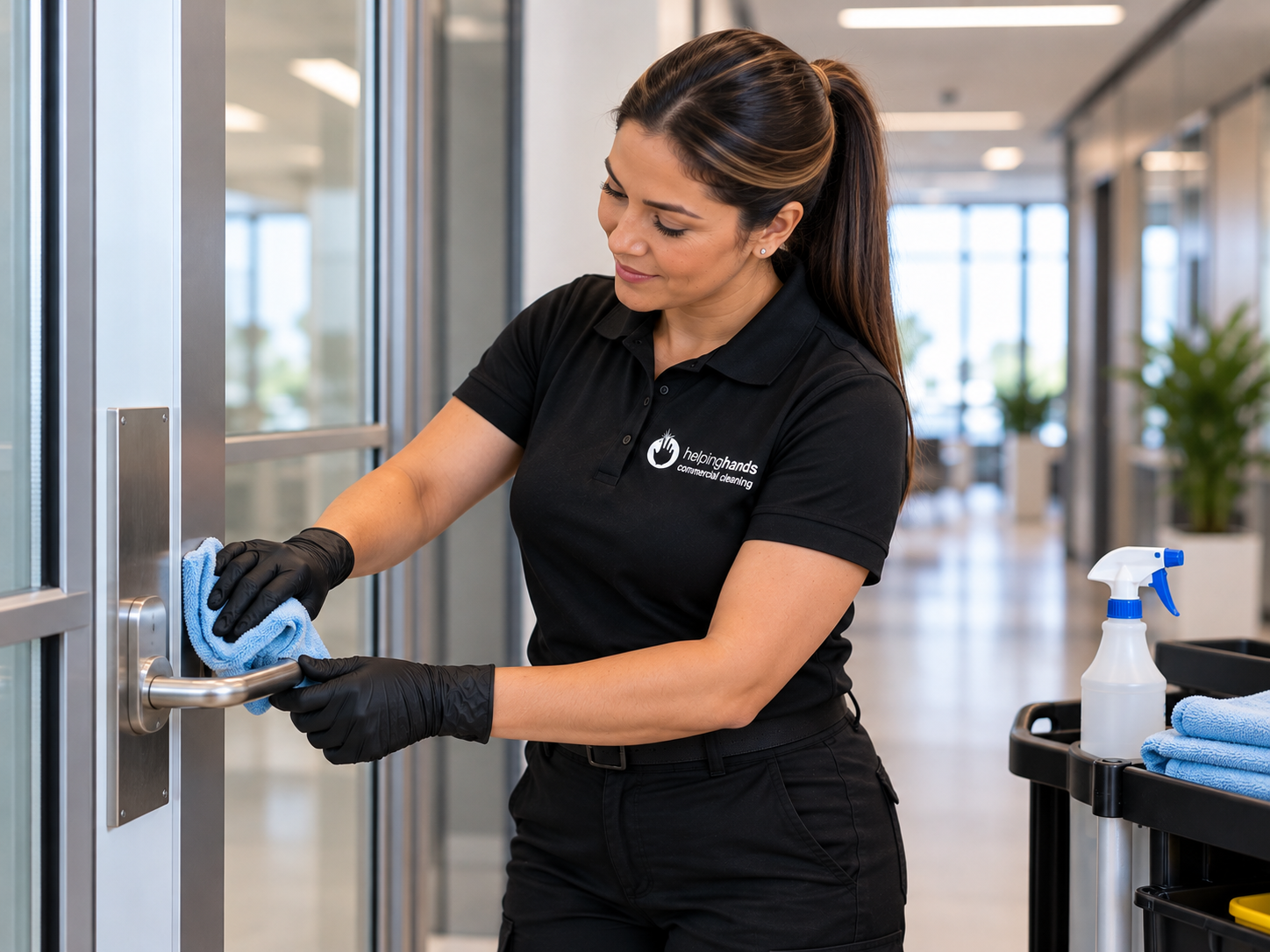
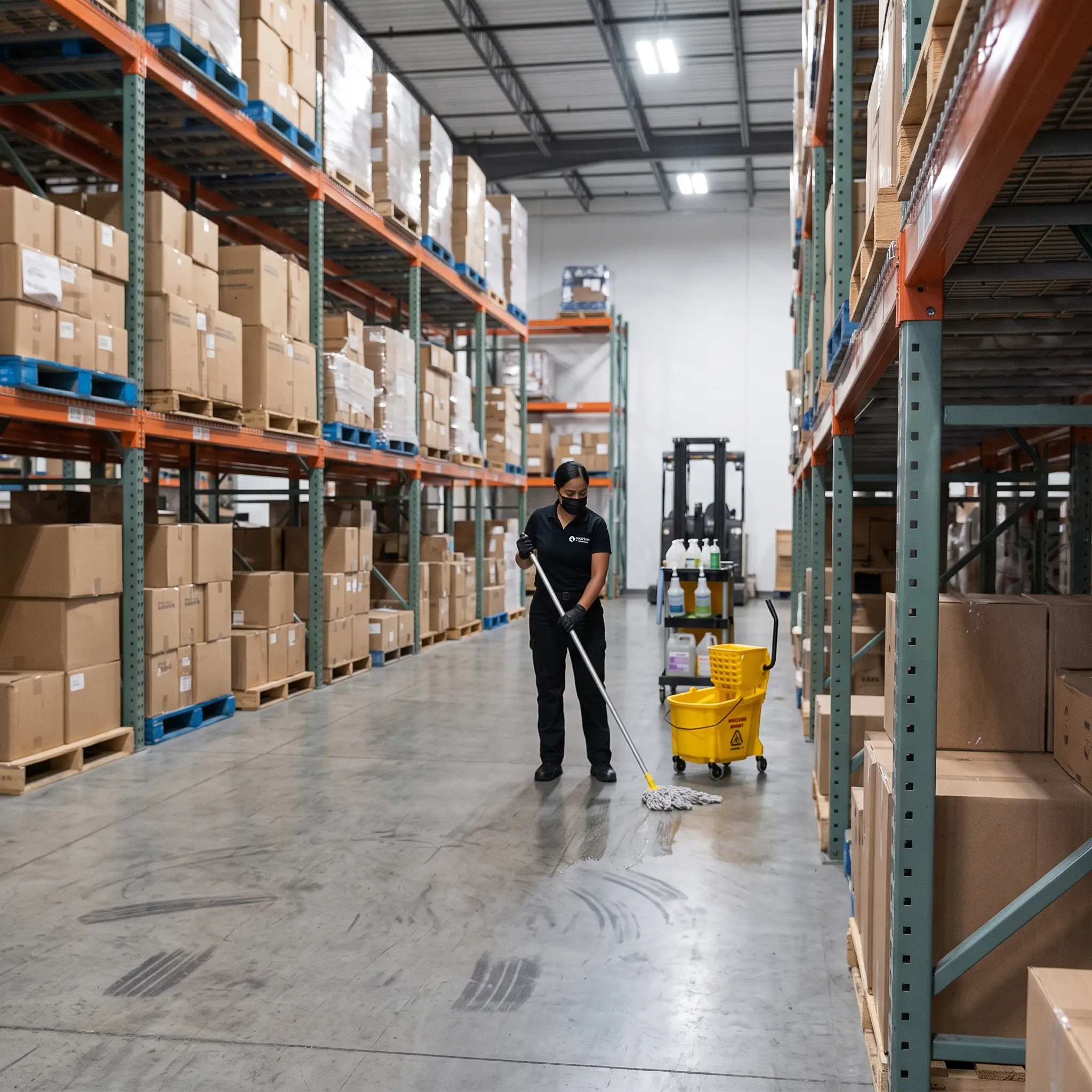
A distribution center doesn’t stop moving just because the day shift ends. Product keeps flowing, forklifts keep running, and whatever gets spilled at 2 PM sits on the floor until whoever’s on the nightly contract shows up — sometimes eight or ten hours later. That gap is exactly why more large Chicagoland warehouses and distribution centers are staffing day porters: technicians on-site during operating hours, not after them, as part of an ongoing commercial cleaning services program rather than a single janitorial services visit per day.
Keep Your Facility Clean, Safe, and Inspection-Ready
Get professional cleaning services tailored to your building.
What a Day Porter Program Actually Covers
Nightly-Only Cleaning | Day Porter Program | |
|---|---|---|
Coverage window | One pass, after close | Continuous, during operating shifts |
Spill / emergency response time | Hours (until next visit) | Minutes |
Restroom/breakroom upkeep across multi-shift use | Degrades by mid-shift | Maintained continuously |
OSHA/safety exposure on active floors | Hazard sits until next visit | Addressed as it happens |
Staffing model | Rotating crew, after hours | Consistent, direct-hire technician on-site |
Nightly-Only Cleaning
Day Porter Program
Coverage window
One pass, after close
Continuous, during operating shifts
Spill / emergency response time
Hours (until next visit)
Minutes
Restroom/breakroom upkeep across multi-shift use
Degrades by mid-shift
Maintained continuously
OSHA/safety exposure on active floors
Hazard sits until next visit
Addressed as it happens
Staffing model
Rotating crew, after hours
Consistent, direct-hire technician on-site
Continuous floor safety in high-traffic zones
Forklift aisles, loading dock approaches, and pick-pack stations accumulate debris and moisture throughout a shift, not just at closing time. This isn’t a minor issue. According to Bureau of Labor Statistics data cited by OSHA, slips, trips, and falls account for 27% of non-fatal warehouse injuries. A day porter provides emergency response to a spill in minutes. A nightly-only contract means that same spill sits on an active floor for however many hours remain in the shift.
Restroom and breakroom upkeep across multiple shifts
A facility running two or three shifts puts restrooms and breakrooms through far more use than a standard 9-to-5 office, and one nightly service leaves these areas visibly rundown by mid-afternoon. A day porter keeps them at a consistent standard between shift changes, not just once every 24 hours.
Immediate response to spills and incidents
In a distribution environment, a spill isn’t cosmetic. It’s a live safety hazard on a floor where forklifts and foot traffic don’t stop, which is why immediate emergency response matters more here than in almost any other commercial setting. A day porter who’s already on-site responds while the shift is still running; a nightly-only crew responds tomorrow.
Why This Shows Up Specifically at Larger Facilities
Day porter programs aren’t the right fit for every building, and that’s by design: the economics only work once a facility crosses a certain size and shift-complexity threshold. A small office with light daytime traffic doesn’t generate enough continuous mess to justify dedicated on-site staff, so a standard nightly or twice-weekly service covers that just fine.
Large warehouses and distribution centers are a different equation. Running multiple shifts across hundreds of thousands of square feet generates a volume of continuous activity that a once-a-day visit simply can’t keep up with. This same threshold applies to large multi-tenant commercial real estate portfolios and corporate campuses, where property managers face the same math: enough square footage and enough daily traffic eventually makes a day porter cheaper than the liability of not having one. That’s the point where a day porter program stops being a nice-to-have and starts being what prevents safety incidents, OSHA exposure, and the kind of visible neglect that wears on staff morale on a facility floor.
5 Signs Your Facility Needs a Day Porter
You’re running two or more shifts, and the facility never fully closes between them.
Spills or debris are visible mid-shift, not just discovered the next morning by the nightly crew.
Restrooms and breakrooms look neglected by early afternoon, even though they were cleaned the night before.
Your facility exceeds roughly 100,000 square feet, or has enough foot and equipment traffic that a single nightly pass can’t realistically cover it.
You’ve had a near-miss or actual slip-and-fall incident tied to a spill or wet floor that sat too long before anyone addressed it.
You’re running two or more shifts, and the facility never fully closes between them.
Spills or debris are visible mid-shift, not just discovered the next morning by the nightly crew.
Restrooms and breakrooms look neglected by early afternoon, even though they were cleaned the night before.
Your facility exceeds roughly 100,000 square feet, or has enough foot and equipment traffic that a single nightly pass can’t realistically cover it.
You’ve had a near-miss or actual slip-and-fall incident tied to a spill or wet floor that sat too long before anyone addressed it.
If two or more of these apply, a day porter program is worth pricing out — even if it means moving away from a pure deep cleaning or nightly-only arrangement.
What to Ask Before Committing to a Day Porter Program
How many shifts does the facility run, and does traffic stay consistent across all of them? A single-shift operation may not need a dedicated day porter. A multi-shift operation almost always does.
Is the current cleaning contract priced on square footage alone, or does it account for shift volume? Square footage tells you how much space there is, not how much continuous activity is happening inside it.
Is the vendor providing direct-hire staff, or a rotating subcontracted crew? A day porter only becomes a familiar, accountable presence on your floor if it’s the same person showing up, not a different face from a subcontractor pool every week. Our commercial cleaning checklist for Chicagoland facility managers covers this in more depth for any vendor evaluation, not just day porter staffing.
What certifications back the program? Facilities with regulated infection-control or environmental requirements should ask whether the vendor’s technicians carry GBAC certification and use EPA-registered cleaning products, not just general janitorial experience.
How many shifts does the facility run, and does traffic stay consistent across all of them? A single-shift operation may not need a dedicated day porter. A multi-shift operation almost always does.
Is the current cleaning contract priced on square footage alone, or does it account for shift volume? Square footage tells you how much space there is, not how much continuous activity is happening inside it.
Is the vendor providing direct-hire staff, or a rotating subcontracted crew? A day porter only becomes a familiar, accountable presence on your floor if it’s the same person showing up, not a different face from a subcontractor pool every week. Our commercial cleaning checklist for Chicagoland facility managers covers this in more depth for any vendor evaluation, not just day porter staffing.
What certifications back the program? Facilities with regulated infection-control or environmental requirements should ask whether the vendor’s technicians carry GBAC certification and use EPA-registered cleaning products, not just general janitorial experience.
Day porter staffing is also common in corporate office parks, not just industrial facilities — our post on day porter services for Schaumburg corporate facilities covers the office-building version of this same staffing model, and how warehouses covered in our Aurora and Elgin manufacturing cleaning guide compare on frequency needs.
Frequently Asked Questions
What is a day porter in commercial cleaning? A day porter is a cleaning technician stationed on-site during business or operating hours, handling continuous upkeep — spill response, restroom maintenance, high-traffic floor care — rather than a single cleaning pass after the facility closes.
How is a day porter different from a nightly cleaning crew? A nightly crew cleans once, after the facility closes. A day porter is present throughout the operating day, addressing issues in real time, which matters most in facilities running multiple shifts or continuous operations where slip-and-fall exposure (27% of non-fatal warehouse injuries, per BLS/OSHA data) accumulates during active hours.
What size facility actually needs a day porter program? Day porter programs make the most operational and financial sense for large facilities — typically warehouses, distribution centers, and multi-shift industrial operations — where continuous activity generates more mess and safety exposure than a once-daily visit can manage.
Does Helping Hands Commercial Cleaning provide day porter staffing in Chicagoland? Yes. Helping Hands provides direct-hire day porter programs for large warehouse, distribution, and industrial facilities across Chicagoland, staffed with consistent technicians rather than rotating subcontractors.
Helping Hands Commercial Cleaning: Built for Facilities That Don't Stop Moving
Helping Hands Commercial Cleaning provides direct-hire janitorial services and day porter programs for large industrial, warehouse, and distribution facilities across DuPage, Cook, Kane, Lake, and Will Counties. Every technician is direct-hire, not subcontracted, which is what makes a consistent day porter presence possible in the first place.
To evaluate whether a day porter program fits your facility’s shift structure, contact Helping Hands Commercial Cleaning at Call (630) 530-8121.
Written by Gosia Baran, Founder of Helping Hands Commercial Cleaning.