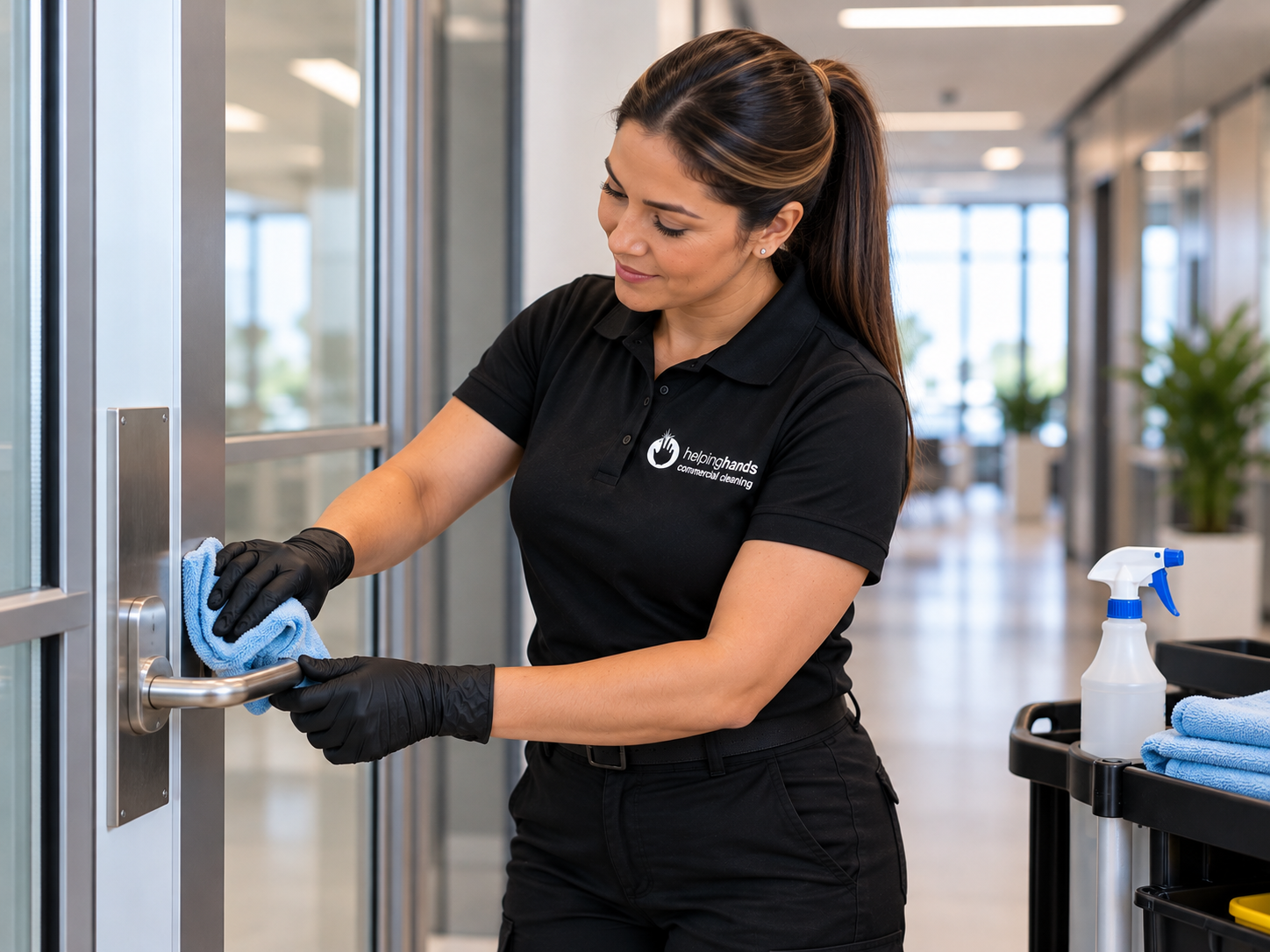
When should a commercial facility be cleaned: before the building opens or after it closes? For early morning commercial cleaning in Chicago, a shift that starts around 4:00 a.m. and finishes by 6, 7, or 8 a.m. gets the building ready before people arrive. Evening cleaning, which begins after about 5:00 p.m. and wraps up by midnight, works when the building empties out at the end of the day. Neither is better in every case. Helping Hands Commercial Cleaning has served Chicagoland since 2001, and this guide explains how to compare service windows so you can choose the one that fits how your facility actually operates.
Keep Your Facility Clean, Safe, and Inspection-Ready
Get professional cleaning services tailored to your building.
Why the Service Window Matters
Cleaning schedules are often set by habit or by whatever the previous vendor did. But the hours a crew works change what they can reach, how easily they can work, and what your staff, tenants, and visitors see when they walk in.
A crew working while the building is empty can clean entrances, restrooms, break rooms, and common areas without interruption. A crew working while people are present has to work around them. The window also decides how fresh the space looks at the moment it matters most: the start of your day. Our janitorial services are scheduled around the operating rhythm of each facility, not the other way around.
Early-Morning Cleaning: What to Know
An early-morning shift begins around 4:00 a.m. and finishes at 6, 7, or 8 a.m., depending on the account. It suits facilities that want to open to a freshly cleaned space every day.
Consider it if:
Your building opens between roughly 6 and 9 a.m. and you want cleaning finished before then
Restrooms and entrances need to be at their best when people first arrive
Your space is empty or lightly used in the early hours
Your building opens between roughly 6 and 9 a.m. and you want cleaning finished before then
Restrooms and entrances need to be at their best when people first arrive
Your space is empty or lightly used in the early hours
Keep in mind: the finish time is set by your opening time, so sharing your first arrivals of the day is part of scoping the work.
Evening Cleaning: What to Know
An evening shift begins after about 5:00 p.m. and is generally completed by midnight. It suits facilities that empty out at the end of the workday.
Consider it if:
Your team leaves by early evening and the space stays quiet afterward
You would rather have the day’s wear cleaned up before the next morning
You want a longer window to work through the whole building
Your team leaves by early evening and the space stays quiet afterward
You would rather have the day’s wear cleaned up before the next morning
You want a longer window to work through the whole building
Keep in mind: evening work needs the building to be accessible and free of late activity, which is worth confirming for facilities that host evening events or meetings.
Side-by-Side Comparison
Early Morning | Evening | Daytime / Day Porter | |
|---|---|---|---|
Typical hours | Starts around 4:00 a.m., ends 6 to 8 a.m. | Starts after about 5:00 p.m., ends by midnight | During business hours |
Best for | Opening to a freshly cleaned space | Cleaning up after the workday | Ongoing upkeep while the building is in use |
Consider | Sets a firm finish time around your opening | Works best when the building is quiet after hours | Handles entrances, restrooms, and spills as they happen |
Early Morning
Evening
Daytime / Day Porter
Typical hours
Starts around 4:00 a.m., ends 6 to 8 a.m.
Starts after about 5:00 p.m., ends by midnight
During business hours
Best for
Opening to a freshly cleaned space
Cleaning up after the workday
Ongoing upkeep while the building is in use
Consider
Sets a firm finish time around your opening
Works best when the building is quiet after hours
Handles entrances, restrooms, and spills as they happen
What Happens When the Window Doesn't Match the Facility
Problems usually come from a mismatch, not from the hours themselves. A crew that finishes after the first people arrive leaves work half-done in front of your staff. A crew that starts while the building is still busy has to skip areas or work around activity. And a schedule set once and never reviewed can drift out of step as your operation changes. Revisiting the window whenever your hours, headcount, or events change keeps the service aligned with the building.
Combining Windows With Day Porter Coverage
A scheduled early-morning or evening clean does the heavy work. A day porter covers what happens in between: restrooms, entrances, break rooms, and spills that appear during the day. The two can work together, so a facility with heavy daily traffic is not left waiting for the next scheduled visit. We explain how this works for high-traffic buildings in our guide on day porter programs for large warehouse and distribution facilities.
Questions to Answer Before Choosing a Window
What time do the first people arrive, and what needs to be ready by then?
When does the building empty out, and does it stay quiet afterward?
Are there evening events, meetings, or activities that would overlap with a cleaning crew?
Which areas, such as restrooms and entrances, need attention during the day as well?
How many days per week does the facility need service?
What time do the first people arrive, and what needs to be ready by then?
When does the building empty out, and does it stay quiet afterward?
Are there evening events, meetings, or activities that would overlap with a cleaning crew?
Which areas, such as restrooms and entrances, need attention during the day as well?
How many days per week does the facility need service?
Why Direct-Hire Crews Matter for Any Window
Whatever the hours, the crew should be the same people every day. Helping Hands Commercial Cleaning employs 100% W-2 trained, bonded, and insured staff, never subcontractors, and runs structured 5 to 7 day recurring maintenance programs with dedicated account management and regular quality control inspections. We serve DuPage, Cook, Kane, Will, and Lake Counties.
Find the Right Window for Your Facility
The best schedule comes from a walkthrough of your building and your operating hours. To talk through your options, request a customized commercial cleaning quote or learn more about Helping Hands Commercial Cleaning. You can also call (630) 530-8121.
Written by Gosia Baran, Founder of Helping Hands Commercial Cleaning.