
What Chicagoland Office and Corporate Facilities Should Expect from a High-Frequency Cleaning Program
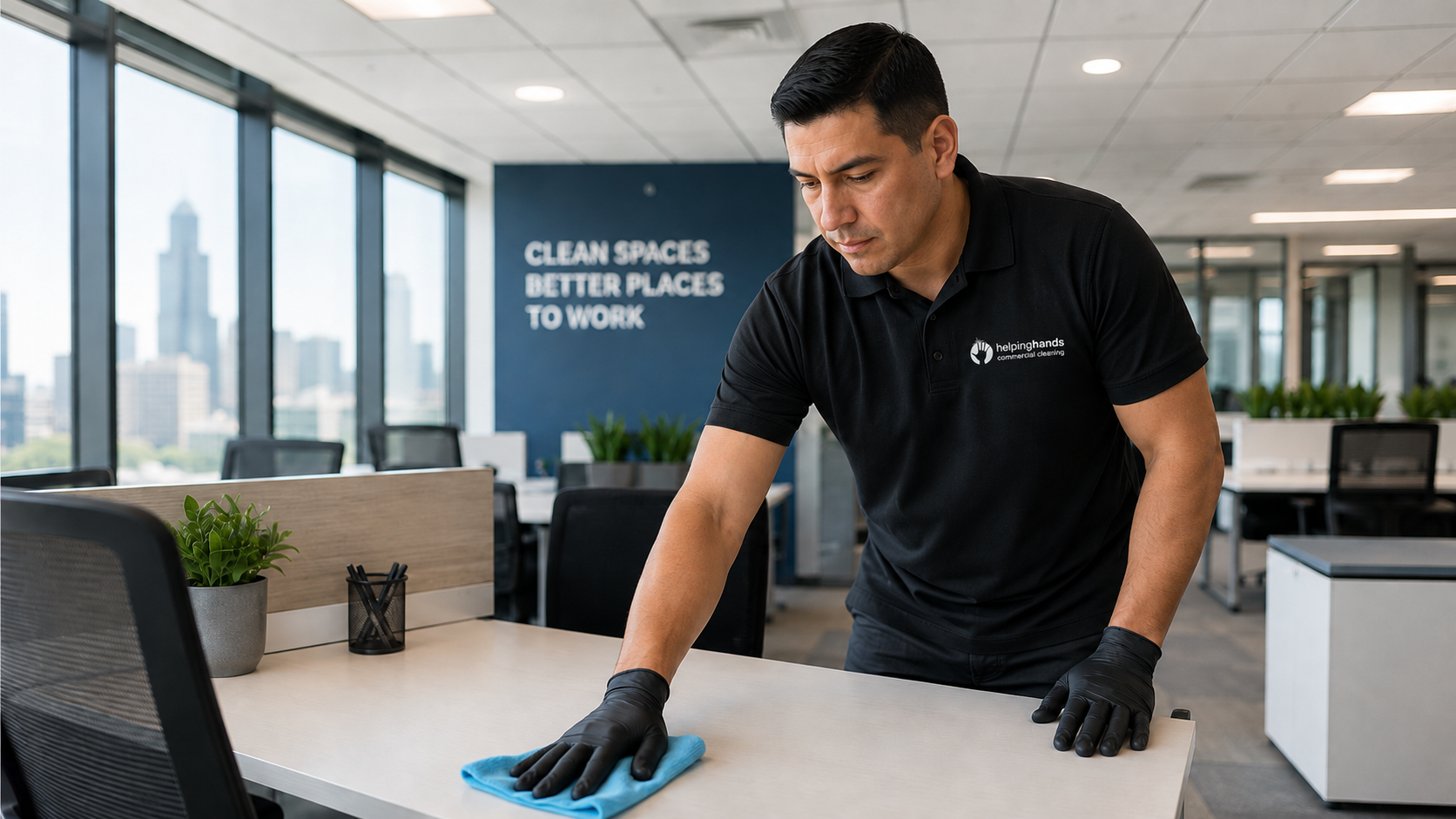
What should office and corporate facilities in Chicagoland expect from a high-frequency commercial cleaning program? Office and corporate facilities in Chicagoland running five or more days per week with consistent employee traffic should expect a cleaning program that covers daily high-touch surface disinfection, restroom and breakroom service calibrated to workforce size, common area and lobby maintenance, and weekly supervisor inspections with photo documentation. A program that delivers only nightly cleaning without daytime accountability, documented inspections, or a consistent crew is not a high-frequency program. It is a low-accountability program running on a daily schedule.
Keep Your Facility Clean, Safe, and Inspection-Ready
Get professional cleaning services tailored to your building.
Why High-Frequency Cleaning Is Not the Same as Frequent Cleaning
The term high-frequency cleaning is used loosely in the commercial janitorial market. Many vendors describe a five-day-per-week schedule as high-frequency without building the program structure that makes that frequency actually work. Showing up every day is not the same as delivering a documented, accountable cleaning program every day.
A genuine high-frequency program for a corporate facility in Chicagoland includes a consistent crew that knows the building, a supervisor who inspects the work on a weekly basis with photo documentation, a defined scope that covers every zone in the facility on a set schedule, and a local point of contact who is reachable when something is missed. Without these components, daily cleaning is just daily cleaning. It is not a program.
Corporate facilities in Chicagoland that have experienced the frustration of inconsistent crews, missed zones, and no accountability when service quality drops have encountered the difference between frequency and program quality firsthand.
What a High-Frequency Program Actually Covers in a Corporate Office Environment
Corporate office environments in Chicagoland vary significantly in size, layout, and workforce density. The cleaning scope has to reflect the actual conditions of the facility, not a generic checklist applied across all accounts.
Daily high-touch surface disinfection covers desks, keyboards, phones, door handles, light switches, elevator buttons, and shared equipment in conference rooms and common areas. In a facility where employees are in contact with these surfaces continuously throughout the workday, daily disinfection is the mechanism that keeps illness from spreading across the workforce and keeps absenteeism from compounding through the week.
Restroom service in a corporate facility serving 50 or more employees requires a service frequency and supply restocking schedule calibrated to actual usage, not an assumption borrowed from a smaller account. Restrooms that run out of supplies or fall behind on cleanliness during the workday are a visible failure of the cleaning program that every employee in the building notices.
Common areas, lobbies, and conference rooms in client-facing corporate facilities are the spaces that create the first and most lasting impression for visitors, vendors, and prospective clients. A lobby that is not maintained during business hours reflects on the organization occupying the building regardless of who is responsible for cleaning it.
Breakrooms in active corporate environments accumulate food debris, packaging waste, and surface contamination at a rate that requires daily attention. A breakroom that is cleaned only at night will be in poor condition by mid-morning in a facility with a large workforce.
The Crew Consistency Problem That Most Corporate Facilities Have Experienced
The most common complaint corporate facility managers in Chicagoland have about their current cleaning vendor is not price. It is crew consistency. The vendor sends a different team every week, or every few days, and the building never gets cleaned the same way twice because nobody knows the facility well enough to clean it correctly without supervision.
Crew inconsistency in a corporate office environment creates compounding problems. Zones get missed because the crew does not know where they are. Standards drift because there is no institutional knowledge of what the facility requires. Security is compromised because the building manager does not know who is in the building or whether their background has been verified.
Direct-hire cleaning employees who are assigned to specific accounts develop facility knowledge over time. They know which conference rooms need extra attention on Mondays after weekend events, which restrooms serve the heaviest traffic, and which areas the facility manager cares about most. That knowledge produces better cleaning outcomes than a rotating crew of unknown personnel who are learning the building at the same time they are supposed to be cleaning it.
Why Corporate Facilities Need Daytime Accountability, Not Just Nightly Service
Most commercial cleaning programs are structured around nightly service: a crew arrives after business hours, cleans the facility, and leaves before employees arrive in the morning. For low-traffic environments, this model works. For active corporate facilities in Chicagoland running large workforces across a full business day, nightly-only service leaves the building unattended for the hours when it needs the most support.
High-traffic lobbies, restrooms serving hundreds of employees, and common areas used continuously throughout the day cannot be maintained exclusively through nightly service. Porter service during business hours addresses the gap: a trained, uniformed direct-hire employee maintains the facility during operating hours, responding to spills, restocking supplies, and keeping high-traffic areas presentable while the workforce is present.
Corporate facilities that add daytime porter coverage to a nightly cleaning program eliminate the visible service failures that nightly-only cleaning cannot prevent. The lobby that looked perfect at 7 AM does not look the same at 2 PM without someone maintaining it.What Weekly Inspections Mean for Corporate Facility Managers
Corporate facility managers are accountable to building ownership, corporate real estate teams, and the employees and clients who occupy the space. A cleaning vendor that delivers service without documentation gives the facility manager nothing to work with when questions arise about service quality.
Weekly supervisor inspections with photo documentation create a performance record that belongs to the facility manager, not just the cleaning company. That record shows what was inspected, what condition each zone was found in, and what was addressed during the inspection visit. When a building owner asks about cleaning quality, or an employee raises a concern, or a corporate real estate review includes facility condition as a metric, the facility manager with documented inspection records is in a fundamentally stronger position than the one relying on verbal assurances.
A cleaning vendor that resists documented inspections is a vendor that does not want a performance record. That resistance is itself the answer to the question of whether the program is working.
What to Look for When Evaluating a High-Frequency Cleaning Program for a Corporate Facility
Corporate facility managers in Chicagoland evaluating a high-frequency cleaning vendor should ask four questions before signing a contract. First, are the cleaning employees direct-hire staff with verified background checks, or are they subcontracted personnel? Second, does the program include weekly supervisor inspections with photo documentation delivered to facility management? Third, can the vendor provide references from corporate office facilities of comparable size and workforce density? Fourth, how does the vendor handle crew consistency, and what is the process when the assigned crew changes?
A vendor that can answer all four questions clearly, with documentation available for the ones that require it, has demonstrated the program structure that a corporate facility in Chicagoland actually needs. A vendor that hedges on any of these points has answered the most important question already.
Helping Hands Commercial Cleaning: Corporate Office Programs Across Chicagoland Since 2001
Helping Hands Commercial Cleaning is a woman-owned commercial janitorial company headquartered in Elmhurst, Illinois, serving DuPage, Cook, Kane, Will, and Lake Counties since 2001. The company employs direct-hire employees exclusively, holds GBAC certification for infection-control protocols, and conducts weekly supervisor inspections with photo documentation on every account.
For corporate and office facilities across Chicagoland evaluating a high-frequency cleaning program, Helping Hands offers on-site walkthroughs to assess the specific scope, workforce size, and service frequency requirements of each facility before building a proposal.
To schedule a walkthrough, contact Helping Hands Commercial Cleaning at Call (630) 530-8121.
High-Frequency Cleaning Standards for Chicagoland Offices
Office and corporate facilities weighing a high-frequency cleaning program should expect more than a five-day-a-week schedule. The real standard includes a consistent crew, daily high-touch surface disinfection, restroom and breakroom service calibrated to workforce size, and weekly supervisor inspections with photo documentation. Daytime porter coverage extends that same accountability into business hours, keeping lobbies, restrooms, and common areas presentable while employees and visitors are actually using them. Facility managers who want to see how this structure applies to their own building can request an on-site walkthrough to review scope, workforce size, and service frequency before committing to a program.