How Warehouses and Distribution Centers in Aurora Illinois Manage High-Volume Facility Cleaning
What cleaning standards do warehouses and distribution centers in Aurora, Illinois actually require? Warehouses and distribution centers in Aurora, Illinois require high-frequency janitorial programs built around active receiving and shipping operations, multi-shift workforces, and OSHA compliance obligations that standard commercial cleaning programs are not designed to meet. Facilities in Aurora’s industrial corridors along the I-88 and Route 59 corridors operate at a scale and pace that demands direct-hire crews, documented inspection protocols, and cleaning schedules coordinated with warehouse management teams.
Keep Your Facility Clean, Safe, and Inspection-Ready
Get professional cleaning services tailored to your building.
Aurora's Industrial Corridor and What It Demands from Janitorial Vendors
Aurora is the second-largest city in Illinois and one of the most active logistics and distribution hubs in the Chicagoland area. The industrial corridors along I-88, Farnsworth Avenue, and the Fox Valley industrial zones house warehouses, distribution centers, and manufacturing operations ranging from regional fulfillment operations to national logistics hubs.
Facilities in this corridor share a common set of operational demands: high inbound and outbound freight volume, large workforces moving through the facility across multiple shifts, loading dock exposure to outdoor debris and weather, and production or fulfillment schedules that leave narrow windows for cleaning without disrupting operations. A janitorial program built for a standard commercial office cannot address any of these requirements effectively.
The Cleaning Challenges Specific to High-Volume Distribution Centers
Distribution centers and warehouses in Aurora generate cleaning challenges that are fundamentally different from standard commercial environments. Understanding these challenges is the starting point for building a program that actually works.
Floor maintenance is the most visible challenge. High-volume forklift traffic, pallet jack lanes, and constant foot traffic across receiving, staging, and shipping zones create soil accumulation, grease buildup, and surface wear at a rate that standard mopping cannot address. Industrial floor scrubbing programs using ride-on or walk-behind scrubbers sized to the facility’s square footage are the baseline requirement, not an upgrade.
Loading dock cleaning is a distinct scope item that many cleaning programs underestimate or omit entirely. Docks accumulate outdoor debris, vehicle residue, packaging waste, and weather-tracked particulate continuously throughout the operational day. Facilities that treat dock cleaning as part of a general floor program end up with docks that fall behind faster than the rest of the building.
Overhead dust accumulation on racking systems, beams, and structural elements creates both a safety hazard and a product contamination risk in distribution environments. Facilities handling consumer goods, food-adjacent products, or pharmaceutical items face regulatory exposure if overhead surfaces are not maintained on a documented rotation.
Restroom and breakroom facilities in high-volume distribution centers serve large workforces moving through these spaces at higher frequency than a typical office building. Service intervals that work for a 50-person office do not work for a 200-person distribution center running two or three shifts.
Why Multi-Shift Operations Require a Different Cleaning Model
The defining operational challenge for warehouses and distribution centers in Aurora is the shift structure. Facilities running evening and overnight shifts cannot simply schedule cleaning for after business hours, because there are no after business hours. Cleaning has to happen between shifts, during breaks, or in coordination with specific zones going offline temporarily.
Building a cleaning schedule around a multi-shift distribution operation starts with a walkthrough that maps the facility’s production calendar, identifies the windows where cleaning can occur safely, and assigns scope items to the right time slots. A vendor that proposes a fixed nightly schedule without understanding the shift structure of the facility is not ready to service a high-volume distribution center.
Direct-hire cleaning employees who are trained on the facility’s specific layout and operational protocols can work within these constraints reliably. Rotating subcontractor crews who arrive without facility-specific knowledge create friction at exactly the moments when the operation can least afford it.
What OSHA Expects from Warehouses and Distribution Centers in Illinois
OSHA housekeeping standards for warehouses and distribution facilities in Illinois focus on three areas that directly intersect with the janitorial program: walking-working surface conditions, hazard communication for cleaning chemicals used on-site, and aisle and exit clearance maintenance.
Facilities that document their cleaning program, maintain inspection records, and can demonstrate consistent service frequency are in a substantially stronger position during an unannounced OSHA inspection than facilities relying on verbal assurances from a cleaning vendor. A documented weekly inspection report from the janitorial company becomes part of the facility’s compliance record.
Distribution centers in Aurora that operate across multiple shifts have an additional compliance consideration: the facility condition at the start of each shift is a reflection of what happened on the previous one. A cleaning program that only services the facility once per day leaves two shifts operating in conditions they did not create and cannot control.
Direct-Hire Crews and Why They Matter in Aurora's Distribution Centers
High-volume distribution centers in Aurora cannot afford the accountability gaps that come with subcontractor-based cleaning models. Facilities with controlled access, valuable inventory, and active receiving and shipping operations require cleaning crews whose backgrounds have been verified, whose training is documented, and who have a direct employment relationship with the company responsible for their work.
When a subcontractor crew misses a zone, damages equipment, or creates a safety incident, accountability disappears into a chain of vendors with no direct relationship to the facility. When a direct-hire crew has an issue, there is one company responsible and one local point of contact who answers for it.
For warehouse managers and distribution center operations directors in Aurora, the staffing model of the cleaning vendor is not a secondary consideration. It is a core qualification.
What a High-Frequency Warehouse Cleaning Program Looks Like in Practice
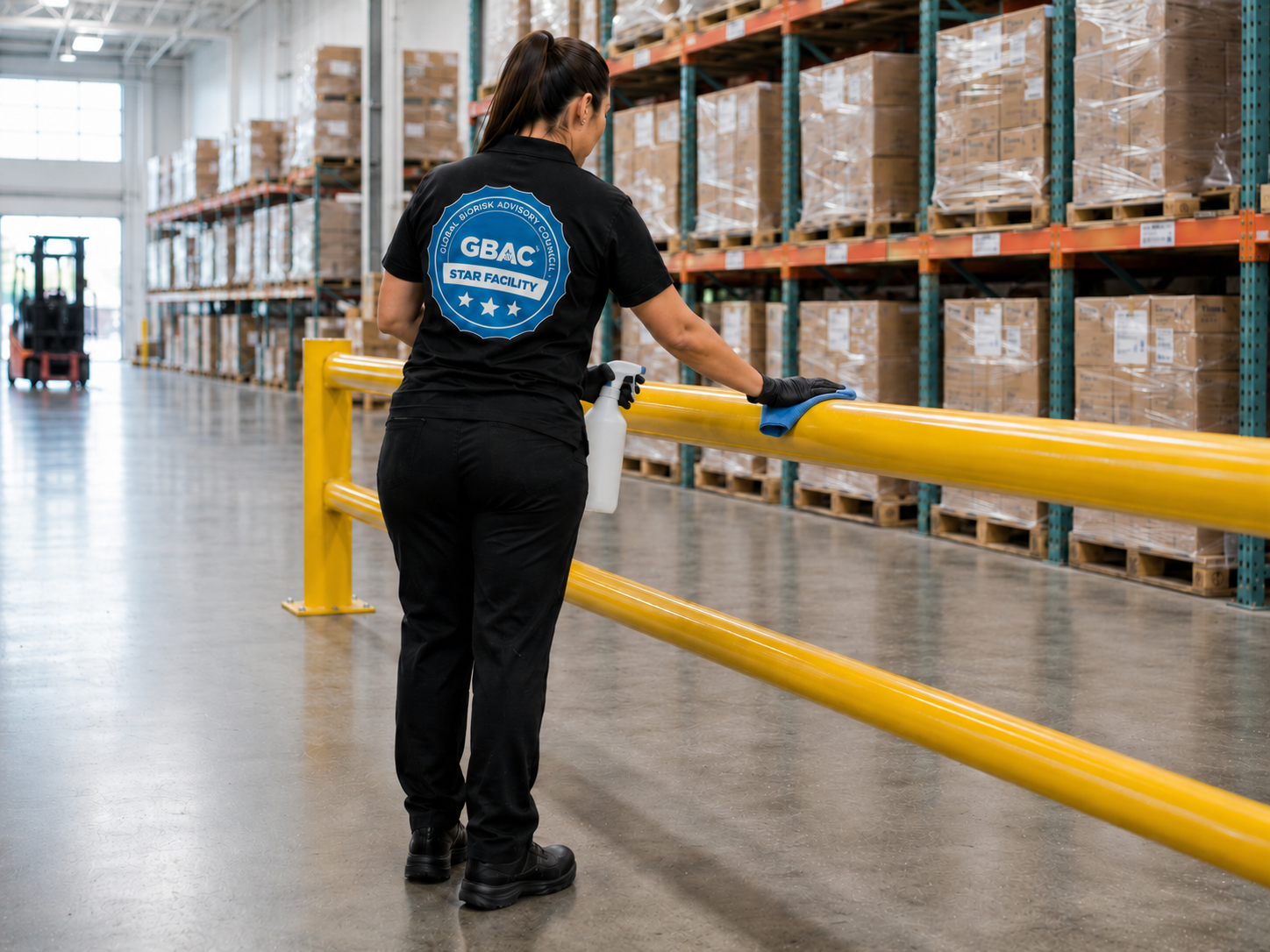
A properly scoped janitorial program for a warehouse or distribution center in Aurora typically includes daily or multi-shift floor scrubbing across receiving, staging, and shipping zones, loading dock cleaning covering debris, vehicle residue, and outdoor particulate, overhead dusting of racking systems and structural elements on a documented rotation, restroom and breakroom service calibrated to workforce size and shift count, office area janitorial for administrative spaces within the facility, and weekly supervisor inspections with photo documentation delivered to facility management.
The program is built during an on-site walkthrough that assesses square footage, shift structure, soil load, and compliance requirements. No two distribution centers in Aurora operate identically, and no two cleaning programs should be identical either.
Helping Hands Commercial Cleaning: Serving Aurora Warehouses and Distribution Centers Since 2001
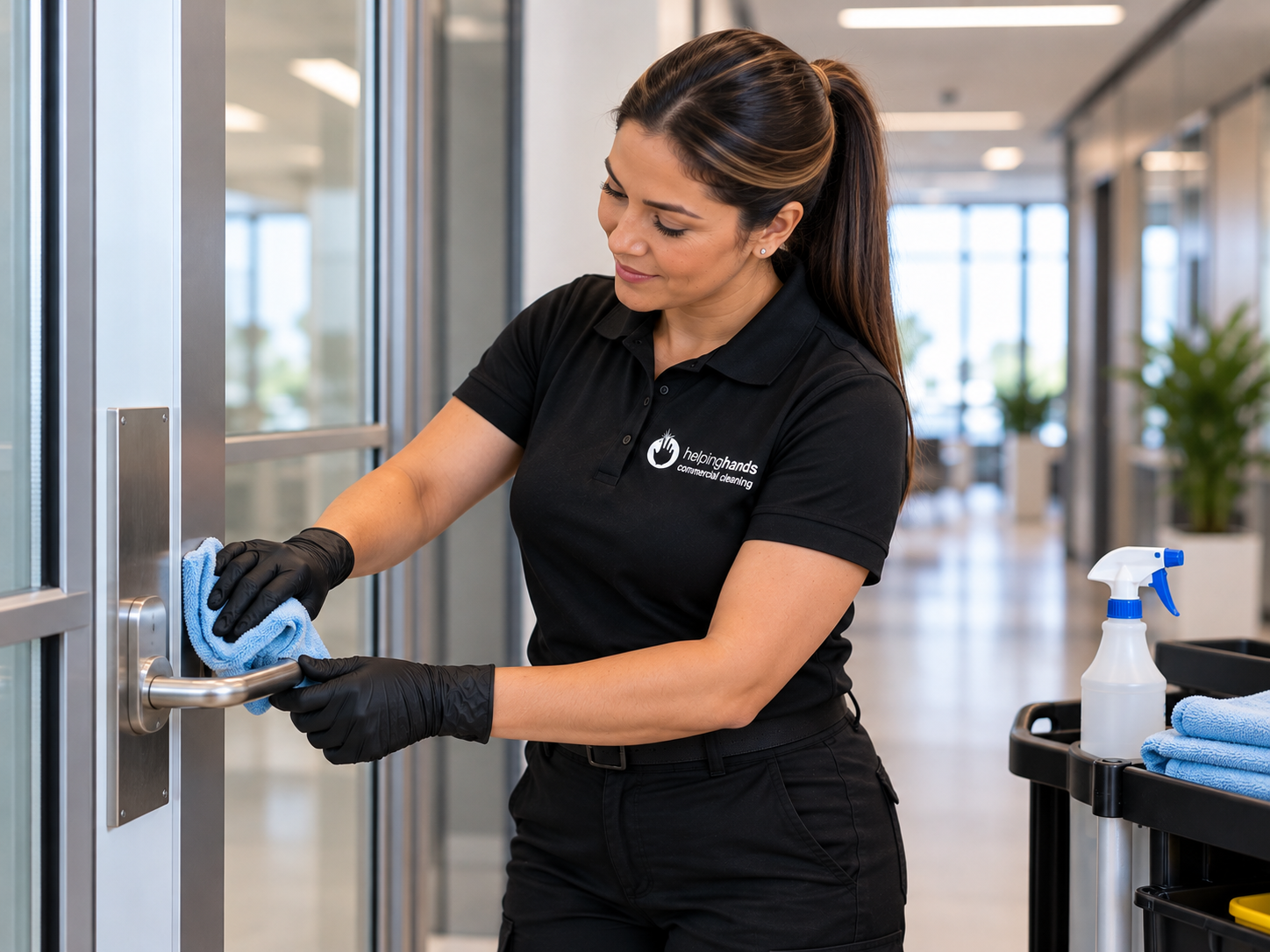
Helping Hands Commercial Cleaning is a woman-owned commercial janitorial company headquartered in Elmhurst, Illinois, serving DuPage, Cook, Kane, Will, and Lake Counties since 2001. The company employs direct-hire employees exclusively, holds GBAC certification for infection-control protocols, and conducts weekly supervisor inspections with photo documentation on every account.
For warehouses and distribution centers in Aurora and the Fox Valley industrial corridor, Helping Hands offers on-site walkthroughs to assess the specific cleaning scope, shift structure, and compliance requirements of each facility before building a program.
To schedule a walkthrough, contact Helping Hands Commercial Cleaning at Call (630) 530-8121.