How should schools and medical offices in Chicagoland prepare their facilities for flu season? Schools and medical offices in Chicagoland should prepare for flu season by establishing high-frequency disinfection protocols for all high-touch surfaces before October, confirming that their janitorial vendor holds GBAC certification for infection-control standards, and verifying that the cleaning crew assigned to their facility is consistent, background-checked, and trained specifically for the environment they are servicing. Facilities that wait until flu season is already underway to address gaps in their cleaning program absorb the consequences of those gaps in student absenteeism, staff illness, and patient exposure before they have the opportunity to correct them.
Keep Your Facility Clean, Safe, and Inspection-Ready
Get professional cleaning services tailored to your building.
Why September Is the Right Month to Act
Flu season in Chicagoland typically begins building in October and peaks between December and February. The window between September and the end of October is the last opportunity for facility managers at schools, medical offices, and healthcare clinics to evaluate their current cleaning program, identify gaps, and make adjustments before the season’s transmission rates begin to climb.
Facilities that act in September arrive at October with a program that has already been calibrated for the season. Facilities that wait until November are adjusting a program in the middle of peak transmission, when the cost of every gap is measured in sick students, absent staff, and patient exposure events that were entirely preventable.
The cleaning program is not the only factor in flu season preparedness, but it is the factor that facility managers control directly. HVAC maintenance, vaccination programs, and individual hygiene practices all play a role. The janitorial program is the one the facility manager owns, and September is the month to make sure it is ready.
What High-Touch Surface Disinfection Actually Means in a School Environment
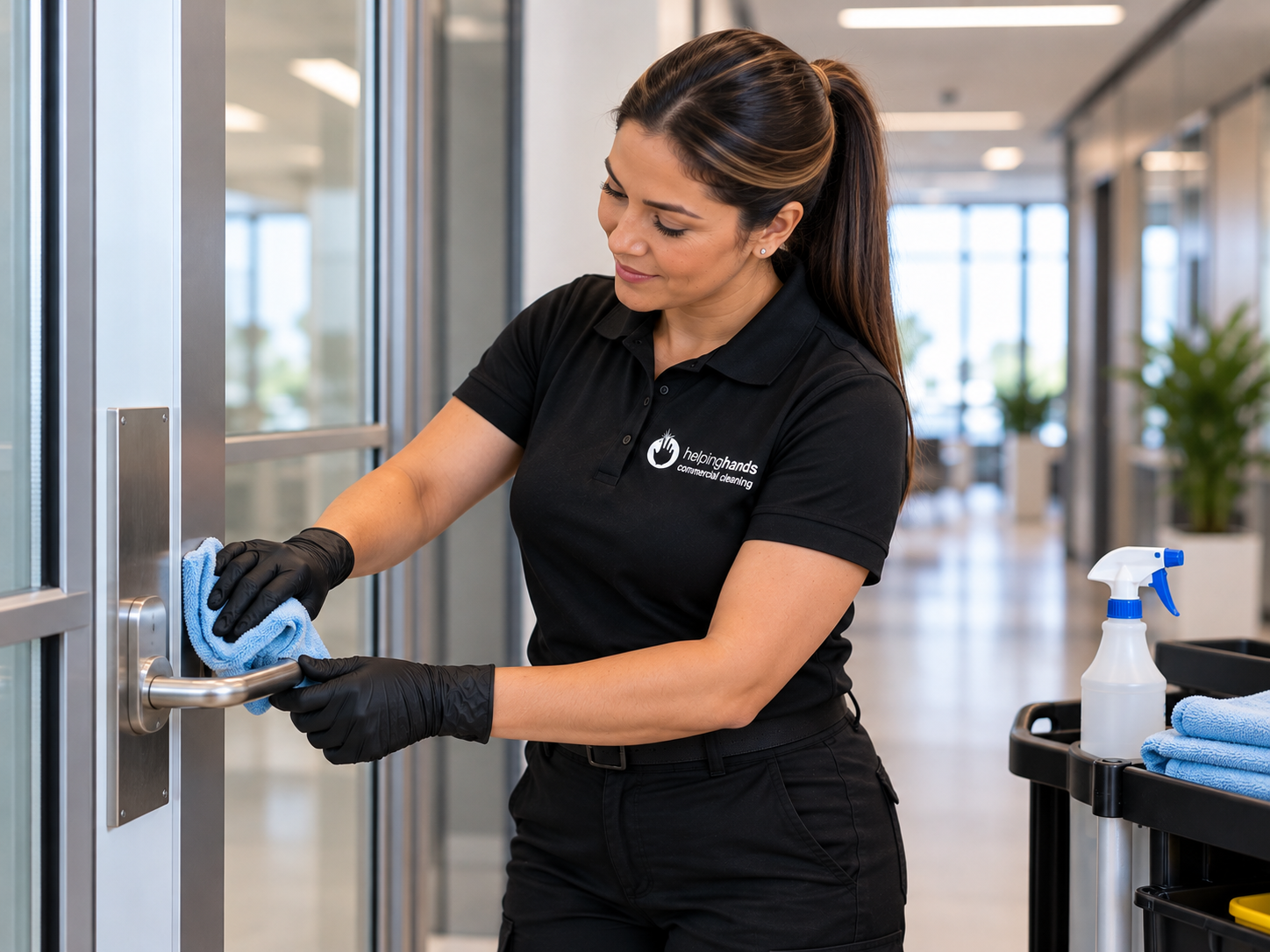
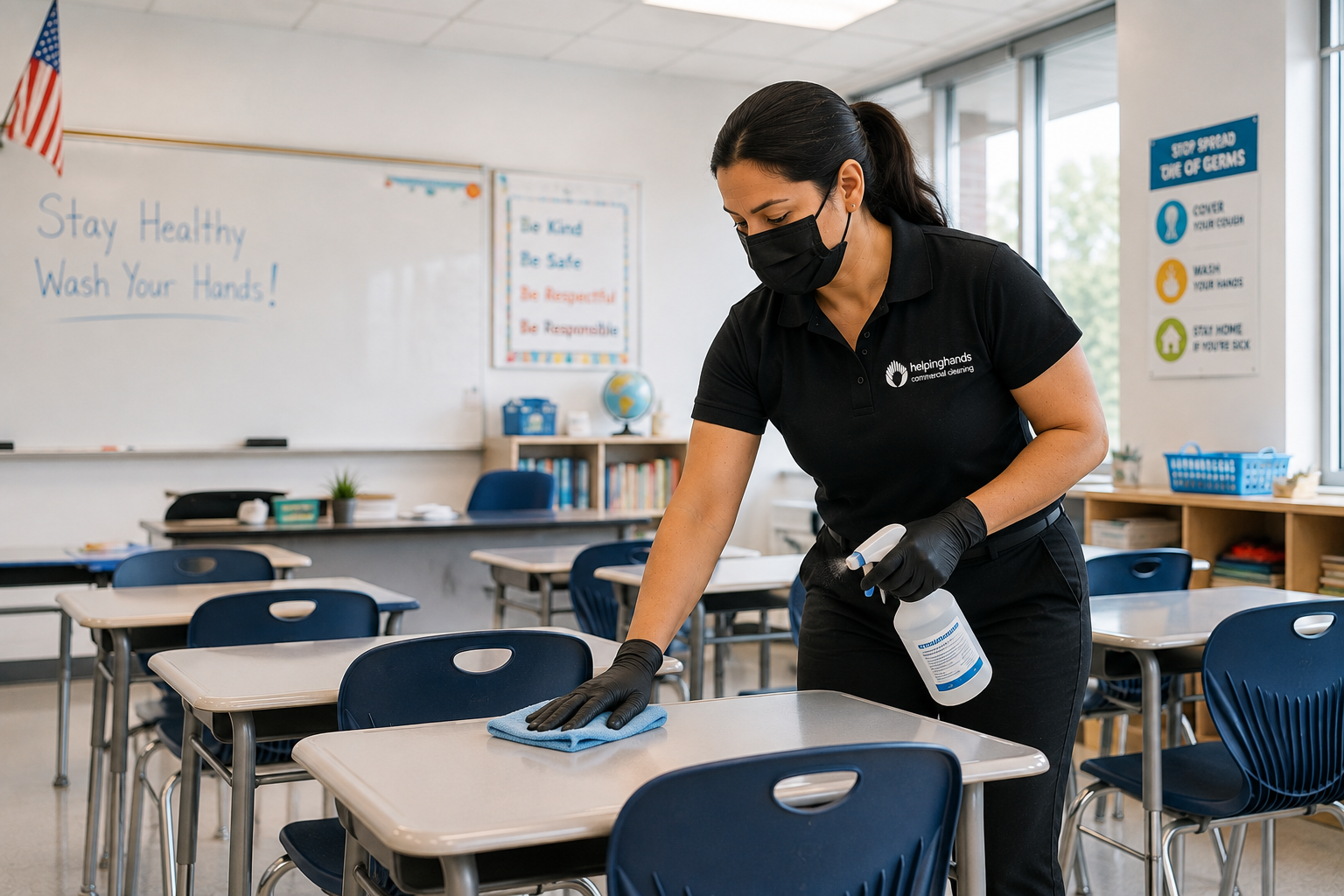
High-touch surface disinfection in a K-12 school environment covers every surface that students contact repeatedly throughout the school day: desks, chairs, door handles, light switches, shared technology including keyboards, tablets, and interactive displays, cafeteria tables and chairs, gymnasium equipment, restroom fixtures, and any shared materials in classroom or common areas.
In a school serving hundreds of students across multiple grades in a shared building, these surfaces are contact points for every strain of illness circulating in the student population at any given time. Daily disinfection of these surfaces is not a precautionary measure. It is the primary mechanism for reducing transmission in an environment where close contact is unavoidable and the population being served has limited ability to modify their own behavior to reduce exposure.
Schools in Chicagoland that are serviced by cleaning programs that address high-touch surfaces only during nightly cleaning cycles are leaving those surfaces unaddressed for the entire school day. A surface disinfected at midnight and touched by two hundred students between 8 AM and 3 PM has not been disinfected for the purposes of flu season control. It has been cleaned and then contaminated again before anyone returns to address it.
What Flu Season Preparation Looks Like for Medical Offices and Clinics
Medical offices and clinics in Chicagoland face a different version of the flu season challenge than schools. Where schools manage high-touch surface transmission across a large student population, medical offices manage the overlap between sick patients arriving for treatment and other patients, staff, and visitors who are present in the same waiting areas, restrooms, and examination rooms.
Waiting rooms in medical offices during flu season are environments where symptomatic and asymptomatic individuals share surfaces in close proximity for extended periods. The cleaning protocol for these spaces during flu season has to address surface disinfection between patient waves, not just at the end of the day. A waiting room that is cleaned once at midnight cannot maintain an infection-control standard through a full day of patient traffic during peak flu season.
Examination rooms require disinfection between appointments. Restrooms serving a medical office during flu season require service intervals calibrated to patient volume, not to a standard commercial office assumption. The cleaning program that works adequately for a medical office in July will fall short of what that same office needs in November without adjustments made in September.
GBAC Certification and Why It Is the Standard for Flu Season Preparedness
GBAC certification establishes the cleaning industry’s highest standard for biosafety and infection-control protocols. For schools and medical offices preparing for flu season in Chicagoland, GBAC certification is the clearest available signal that the cleaning vendor’s program is built on verified infection-control science rather than general commercial cleaning assumptions.
A GBAC-certified cleaning program covers the specific disinfectants, application methods, contact times, and surface protocols that produce verifiable infection-control outcomes. A non-certified program may use commercial-grade cleaning products applied with general commercial cleaning methods that are not optimized for pathogen reduction in high-risk environments.
For school business managers and medical office administrators presenting their flu season preparedness plan to a board of education, a medical director, or a compliance team, a GBAC-certified cleaning vendor is documentation. It demonstrates that the sanitation program meets a recognized external standard rather than an internal assumption about what clean means.
Why Crew Consistency Matters More During Flu Season
Flu season is the period when the consequences of crew inconsistency in a school or medical facility become most visible. A rotating subcontractor crew that does not know the facility’s specific high-touch zones, does not follow the disinfectant protocols established for patient or student areas, and is not supervised with documented inspections will produce inconsistent results precisely when consistent results matter most.
Direct-hire cleaning employees assigned to specific schools and medical offices develop facility knowledge that makes their disinfection protocols more effective over time. They know which surfaces receive the highest student or patient contact, which zones the facility manager considers highest priority, and which areas have specific protocol requirements that differ from the rest of the building. That knowledge is not transferable to a rotating crew that encounters the facility without context.
Weekly supervisor inspections with photo documentation during flu season give school administrators and medical office managers a verified record of what was disinfected, when, and to what standard. That record is the difference between a facility that can demonstrate its infection-control program and one that can only describe it.
How to Evaluate Whether Your Current Cleaning Program Is Flu Season Ready
The evaluation has four components. The first is certification: does your current vendor hold GBAC certification, and can they produce that documentation on request? The second is staffing: are the employees cleaning your facility direct-hire staff with verified backgrounds, or are they subcontracted personnel whose rotation you cannot control or verify? The third is inspection documentation: does your vendor deliver weekly inspection reports with photo verification to your facility management team? The fourth is protocol specificity: has your vendor conducted a walkthrough of your facility to identify the specific high-touch zones, approved disinfectants, and service frequency requirements for your environment during flu season?
A vendor that satisfies all four components has a program that can maintain an infection-control standard through flu season. A vendor that cannot satisfy any one of them has a gap in their program that will become visible between October and February.
Helping Hands Commercial Cleaning: GBAC-Certified Flu Season Programs Across Chicagoland
Helping Hands Commercial Cleaning is a woman-owned commercial janitorial company headquartered in Elmhurst, Illinois, serving DuPage, Cook, Kane, Will, and Lake Counties since 2001. The company employs direct-hire employees exclusively, holds GBAC certification for infection-control protocols, and conducts weekly supervisor inspections with photo documentation on every account.
For schools, medical offices, and healthcare facilities across Chicagoland preparing for flu season, Helping Hands offers on-site walkthroughs to assess the specific disinfection scope, high-touch surface protocols, and service frequency requirements of each facility before the season begins.
To schedule a walkthrough before flu season, contact Helping Hands Commercial Cleaning at Call (630) 530-8121