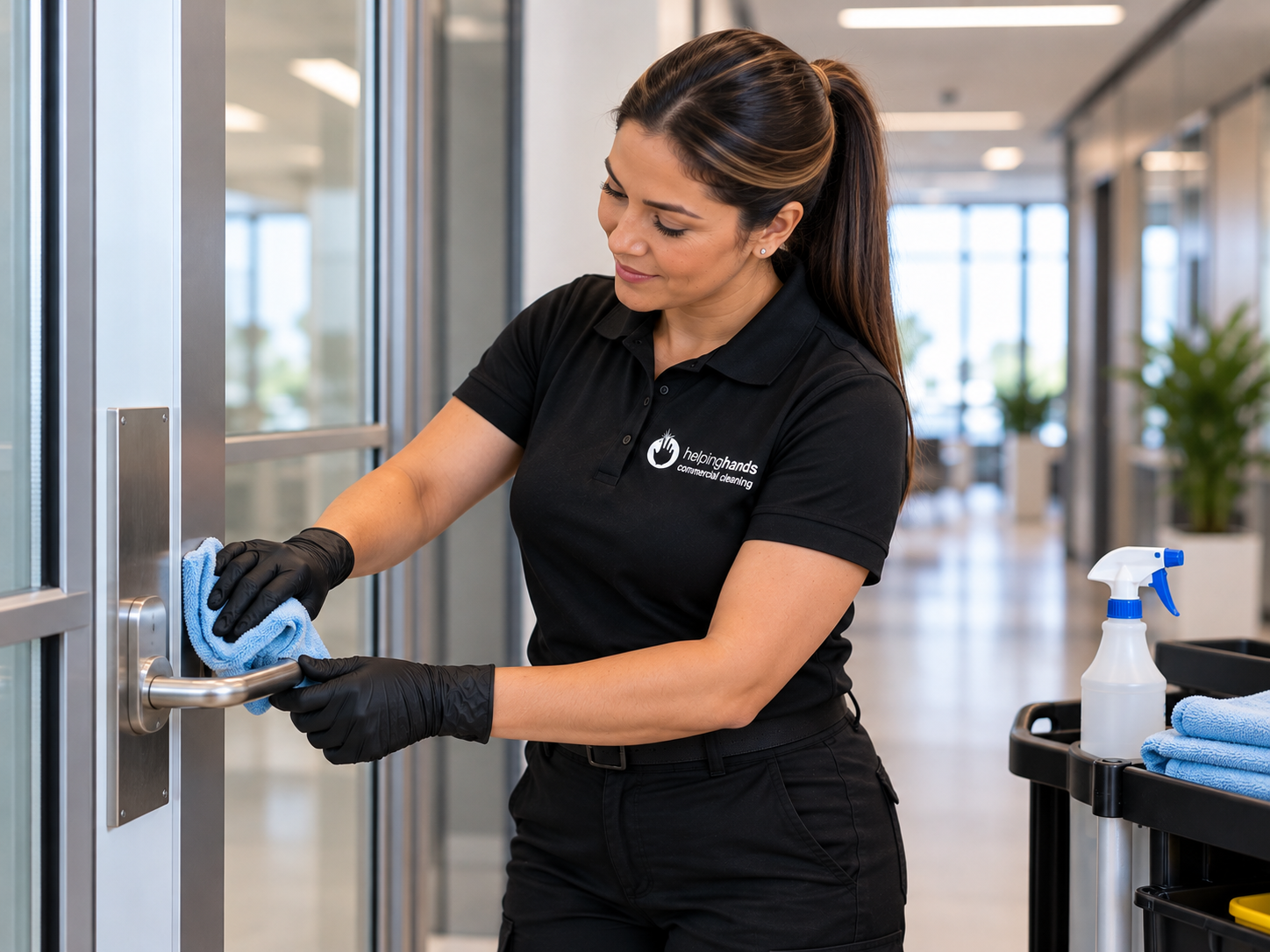
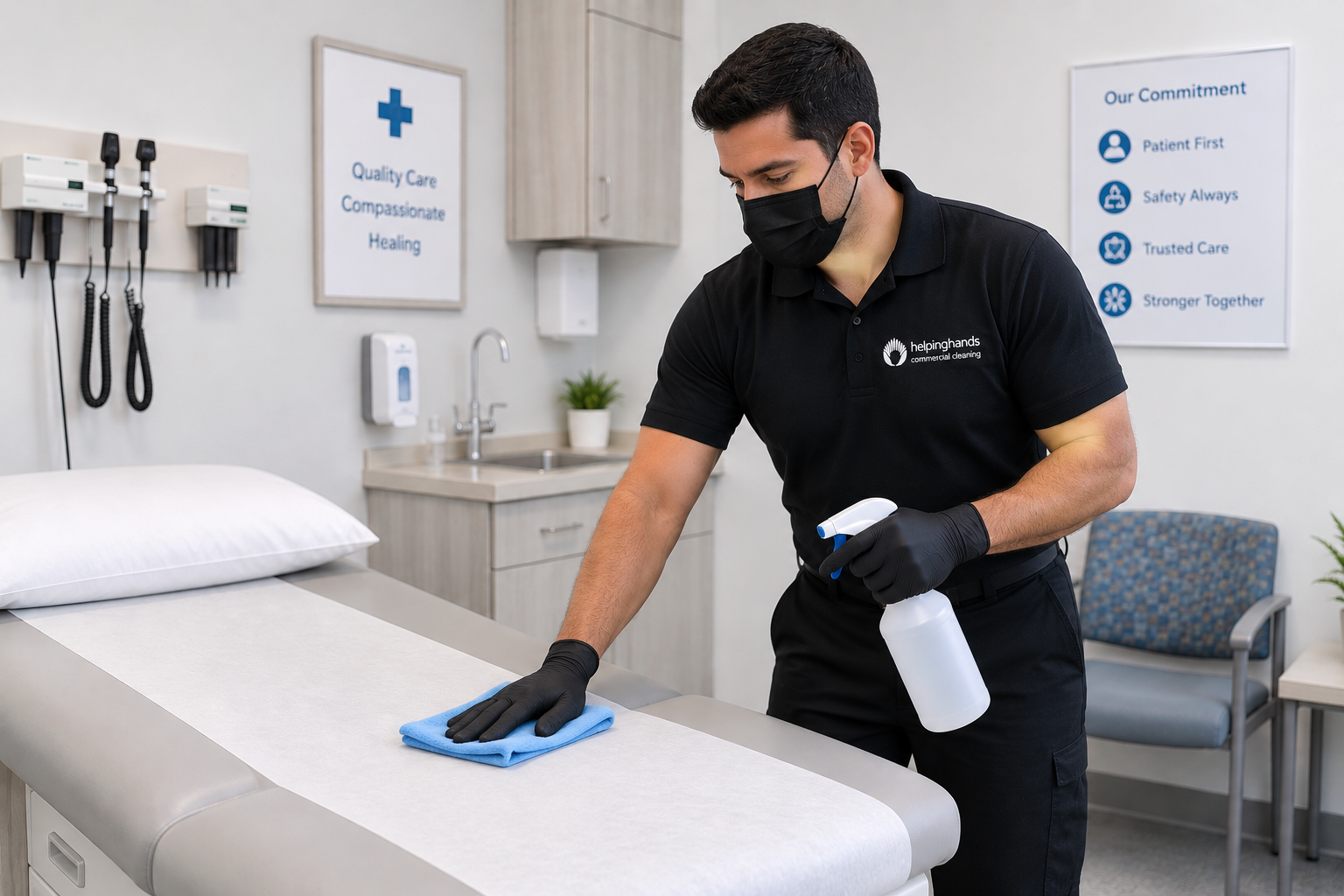
What do medical clinics and healthcare facilities in Chicagoland actually require from a commercial cleaning vendor? Medical clinics and healthcare facilities in Chicagoland require cleaning vendors with GBAC certification, direct-hire background-checked employees, documented infection-control protocols for patient-facing areas, and weekly inspection reports that facility directors can present during Joint Commission reviews, insurance audits, and corporate compliance evaluations. A standard commercial cleaning contract applied to a healthcare environment creates compliance gaps that facility managers discover at the worst possible moment, during an inspection, after a patient complaint, or when an outbreak traces back to inadequate sanitation protocols.
Keep Your Facility Clean, Safe, and Inspection-Ready
Get professional cleaning services tailored to your building.
Why Healthcare Cleaning Is a Different Category Entirely
Medical clinics, behavioral health facilities, rehabilitation centers, and ambulatory care operations in Chicagoland operate under a compliance framework that most commercial cleaning vendors are not built to meet. The surfaces being cleaned, the populations being served, and the regulatory expectations that govern these environments require a program that goes beyond what a standard janitorial contract covers.
Patient-facing areas in healthcare facilities are not simply high-traffic spaces. They are environments where infection transmission carries direct consequences for vulnerable populations. A waiting room that is not disinfected between patient waves, an exam room where high-touch surfaces are not addressed between appointments, or a restroom serving a behavioral health facility that falls behind during operating hours is not a cleanliness failure. It is a patient safety failure.
The cleaning vendor in a healthcare facility is part of the infection-control infrastructure of the organization. Regulatory bodies evaluating healthcare facilities during inspections include sanitation protocols and cleaning documentation as part of their assessment. A vendor that cannot produce documented inspection records, approved disinfectant lists, and trained staff certifications on request is a liability for the facility director who is accountable for the environment.
What GBAC Certification Means for Healthcare Facilities
GBAC certification is the cleaning industry’s highest standard for biosafety and infection-control protocols. For medical clinics and healthcare facilities in Chicagoland evaluating a cleaning vendor, GBAC certification is the clearest external signal that the vendor’s program is built on verified science rather than internal assumptions.
For facility directors presenting janitorial vendor decisions to medical leadership, a board of directors, or a corporate compliance team, GBAC certification is documentation. It demonstrates that the cleaning program meets a recognized standard that the organization can point to when the quality of the sanitation protocol is questioned. Vendors without this certification are asking healthcare facility managers to take their word for the quality of their infection-control protocols. That is not a position a healthcare facility can accept.
Direct-Hire Employees in Healthcare Environments
Medical clinics and healthcare facilities in Chicagoland cannot accept unknown personnel in their buildings. Patient privacy requirements, controlled substance security, and the general obligation to maintain a safe environment for vulnerable populations make the staffing model of the cleaning vendor a compliance requirement, not a preference.
Subcontractor cleaning crews rotate through facilities without the direct employment relationship that makes background verification possible and accountability enforceable. When a crew changes in a medical clinic, the facility has no visibility into who replaced the previous personnel or what their background check status is. In a behavioral health facility, a rehabilitation center, or any environment serving patients with elevated vulnerability, that lack of visibility is not a manageable risk. It is a disqualifying condition.
Direct-hire cleaning employees are background-checked before their first day, employed directly by the company responsible for the account, and trained on the specific protocols of each facility they service before their first visit. That training includes patient area protocols, restricted zone access, disinfectant handling, and the specific documentation requirements of the account. When a compliance officer asks who cleaned the patient wing and what their training record shows, a direct-hire program has answers. A subcontractor chain does not.
The Multi-Location Challenge for Healthcare Organizations
Healthcare organizations in Chicagoland operating multiple clinic locations face an additional cleaning challenge: maintaining consistent standards across facilities that may have different layouts, different patient populations, and different regulatory requirements, all under one vendor relationship.
Each location requires a cleaning vendor that can assess the facility individually, build a scoped program for its specific requirements, and deliver consistent documentation across all locations to one point of contact in the organization. A vendor that applies a template across multiple healthcare locations without individual walkthroughs is not managing a multi-location healthcare account. They are managing a single-template contract that will fall short at the location where the template fits least well.
What a Compliant Healthcare Cleaning Program Looks Like in Practice
A properly scoped cleaning program for a medical clinic or healthcare facility in Chicagoland begins with an on-site walkthrough that maps patient-facing areas, identifies high-risk zones, documents approved disinfectants for each surface type, and establishes the cleaning sequence and verification steps required for compliance.
From that walkthrough comes a program covering daily disinfection of patient areas, exam rooms, waiting rooms, and high-touch surfaces, restroom service calibrated to patient volume and operating hours, staff area and administrative space janitorial, and weekly supervisor inspections with photo documentation delivered to facility management. The program is built around the clinical schedule of the facility, not the scheduling preferences of the cleaning vendor.
Helping Hands Commercial Cleaning: Serving Healthcare Facilities Across Chicagoland Since 2001
Helping Hands Commercial Cleaning is a woman-owned commercial janitorial company headquartered in Elmhurst, Illinois, serving DuPage, Cook, Kane, Will, and Lake Counties since 2001. The company employs direct-hire employees exclusively, holds GBAC certification for infection-control protocols, and conducts weekly supervisor inspections with photo documentation on every account.
For medical clinics, behavioral health facilities, rehabilitation centers, and ambulatory care operations across Chicagoland, Helping Hands offers on-site walkthroughs to assess the specific cleaning scope, compliance requirements, and clinical schedule of each facility before building a program.
To schedule a walkthrough, contact Helping Hands Commercial Cleaning at Call (630) 530-8121.