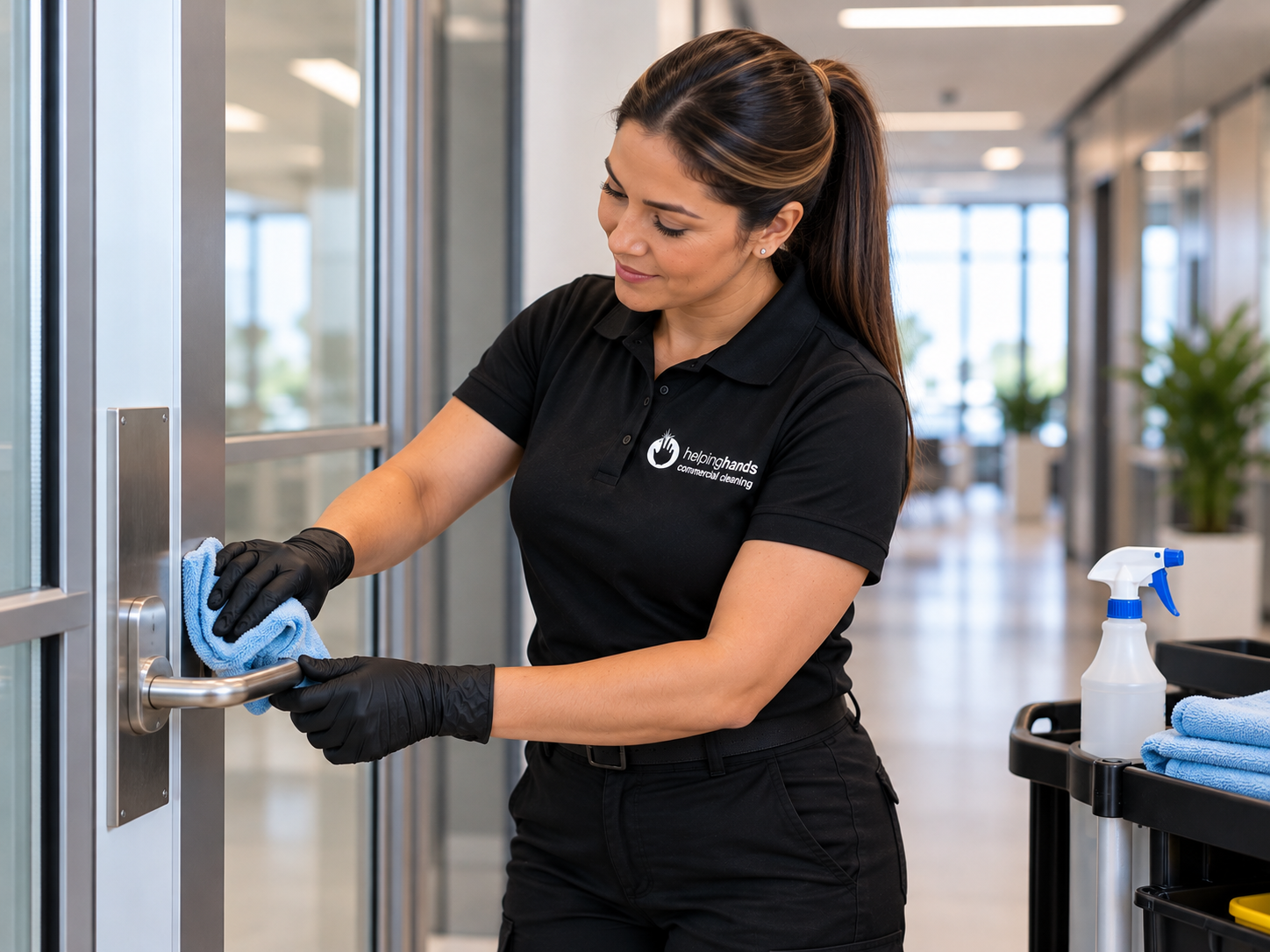
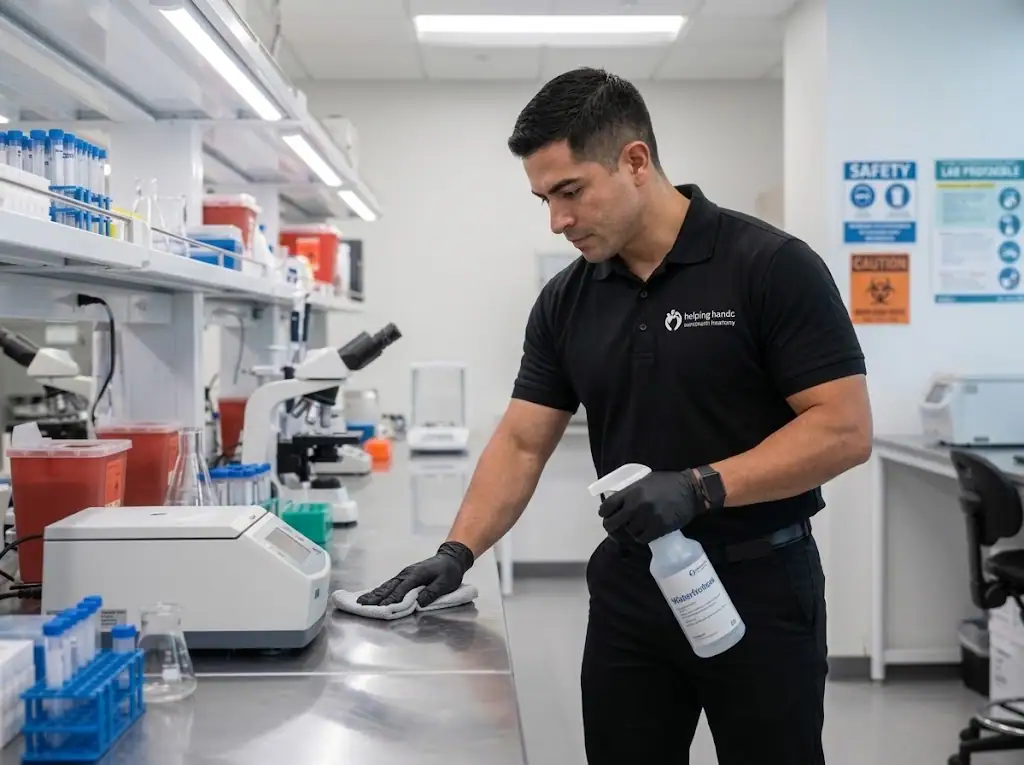
A laboratory or life sciences facility in Aurora and across Chicagoland can’t treat cleaning as a background task. What Contamination-control protocols should a laboratory require from their cleaning vendor? At minimum: color-coded equipment to prevent cross-contamination between zones, technicians trained specifically on lab environments rather than general office cleaning, and documented protocols that hold up under an internal audit. Helping Hands Commercial Cleaning builds these programs specifically for facilities where a cleaning mistake isn’t cosmetic — it’s a compliance failure.
Keep Your Facility Clean, Safe, and Inspection-Ready
Get professional cleaning services tailored to your building.
Why Laboratory Cleaning Is a Different Category Entirely
A standard office cleaning contract assumes uniform surfaces and low contamination risk. A laboratory assumes the opposite. Different zones within the same facility — wet labs, clean rooms, sample storage, general office space — carry different contamination risks and require different protocols for the same technician on the same visit.
Cross-contamination between zones is the core risk a lab-focused cleaning program has to control for. A mop or cloth used in a general office area and then carried into a lab space introduces exactly the kind of variable a facility’s own quality-control process is designed to eliminate. This is why our healthcare and medical facility cleaning program applies the same color-coding discipline we use in clinical settings to laboratory and life sciences accounts — different color, different zone, no exceptions.
What a Contamination-Control Cleaning Program Actually Covers
Color-coded equipment by zone
Every cloth, mop head, and piece of equipment is assigned to a specific zone and never crosses into another. This is the single most important control in preventing cross-contamination, and it’s the first thing a facility manager should verify with any vendor claiming lab experience.
Technicians trained on lab-specific protocols, not general janitorial checklists
A technician who’s only ever cleaned offices doesn’t know why a countertop next to lab equipment requires a different approach than a countertop in a breakroom. Lab-specific training covers what surfaces can and can’t be touched with standard disinfectants, and how to work around active equipment and samples.
Documentation that holds up under audit
Lab and life sciences facilities are frequently subject to internal quality audits and, depending on the work being done, external compliance reviews. A cleaning vendor that can’t produce documented, dated proof of what was cleaned, when, and by whom isn’t a vendor a lab can rely on when that documentation gets requested.
A commercial cleaning company based in Elmhurst, Illinois, serving Chicagoland since 2001, Helping Hands built its health-first standard around exactly this kind of documentation-first approach — GBAC-certified protocols and photo-verified inspections on every account, not just the ones that ask for it.
Why Direct-Hire, GBAC-Certified Staff Matter Most in a Lab Setting
A lab or life sciences facility can’t afford unknown personnel rotating through spaces with active research, sensitive equipment, or regulated samples. Direct-hire technicians are background-checked, trained specifically on the account’s protocols before their first visit, and accountable to a single point of contact — not a subcontractor pool where the facility never knows who’s showing up.
Helping Hands Commercial Cleaning employs W-2 staff exclusively, never subcontractors, and holds GBAC certification for infection-control and contamination protocols — the same standard used in healthcare-grade environments, applied to laboratory accounts. Weekly supervisor inspections with photo documentation give facility managers a continuous, dated record of what was cleaned and how, which matters far more in a regulated lab environment than in a standard office.
What to Ask Before Hiring a Cleaning Vendor for a Lab or Life Sciences Facility
Does the vendor use color-coded equipment by zone, and can they explain their system specifically?
Are technicians trained on lab-specific protocols, or only on general commercial cleaning?
Can the vendor produce dated documentation of cleaning activity for an internal audit?
Is staffing direct-hire, or subcontracted?
Does the vendor use color-coded equipment by zone, and can they explain their system specifically?
Are technicians trained on lab-specific protocols, or only on general commercial cleaning?
Can the vendor produce dated documentation of cleaning activity for an internal audit?
Is staffing direct-hire, or subcontracted?
Helping Hands Commercial Cleaning: Built for Chicagoland's Regulated Facilities
Helping Hands Commercial Cleaning provides GBAC-certified, direct-hire cleaning programs for laboratories, life sciences facilities, and other regulated environments across DuPage, Cook, Kane, Lake, and Will Counties — including Aurora and the surrounding Kane County corridor.
To schedule a walkthrough and scope a contamination-control program for your facility, get a quote or call (630) 530-8121.
Written by Gosia Baran, Founder of Helping Hands Commercial Cleaning.