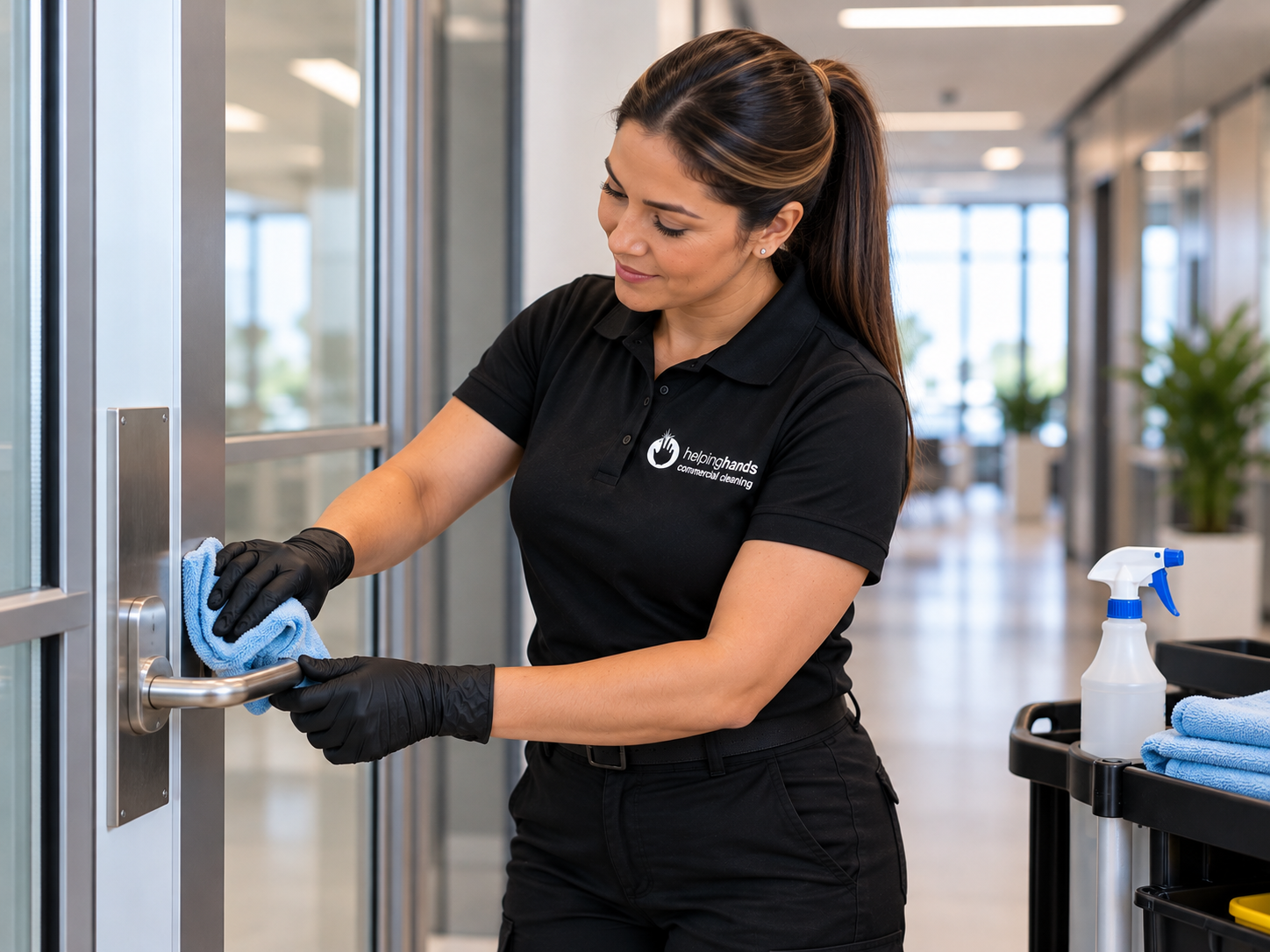
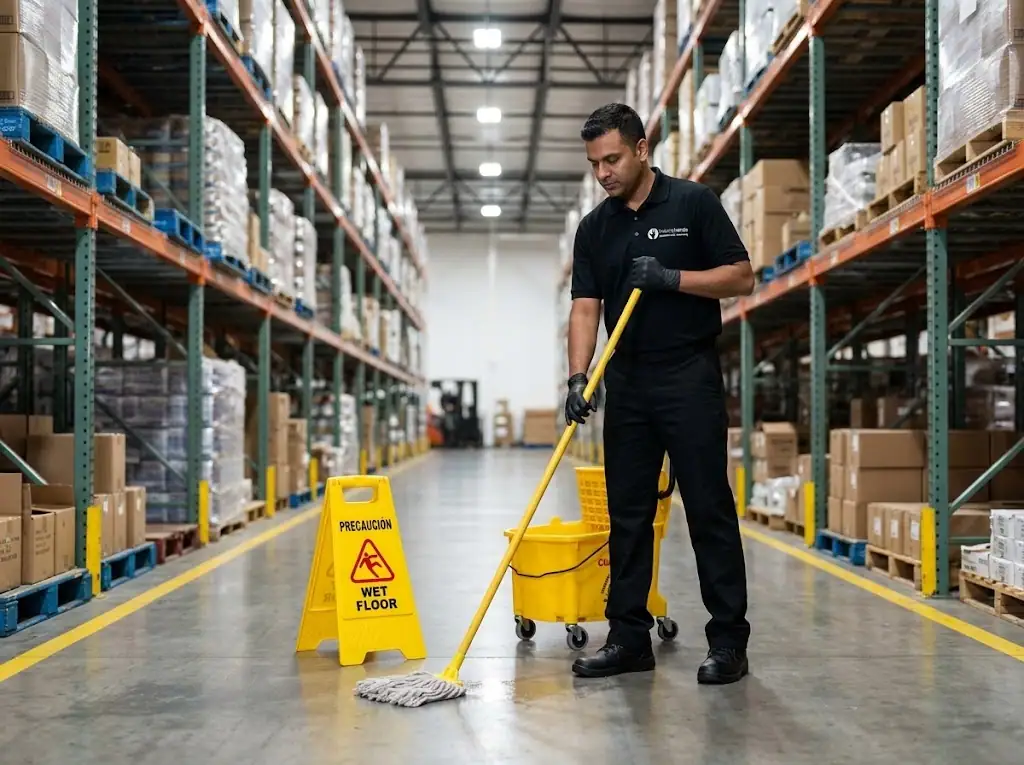
What should an OSHA-conscious facility manager in Mt Prospect require from an industrial cleaning vendor? At minimum: a documented floor-safety protocol, technicians trained specifically on slip-and-fall prevention, and a cleaning schedule built around your facility’s actual traffic — not a generic once-a-day pass. Helping Hands Commercial Cleaning builds industrial programs around the same safety data OSHA itself tracks, because for a manufacturing or warehouse facility, cleaning quality and injury risk are the same conversation.
Keep Your Facility Clean, Safe, and Inspection-Ready
Get professional cleaning services tailored to your building.
Why Floor Safety Is a Compliance Issue, Not Just a Cleanliness One
Slips, trips, and falls account for 27% of non-fatal warehouse injuries, according to Bureau of Labor Statistics data cited by OSHA. That statistic changes what “clean” needs to mean inside an industrial facility. A spill or debris left on an active floor for even a few hours isn’t a cosmetic problem — it’s an open safety exposure that a facility manager is ultimately accountable for.
Most commercial cleaning vendors treat floor care as an aesthetic task: mop it, it looks clean, job done. An OSHA-conscious vendor treats it as a documented safety control: what got cleaned, when, by whom, and what protocol was followed if a spill or hazard was found mid-shift. Our industrial and manufacturing facility cleaning program is built around that distinction specifically for facilities where a missed spot is a liability exposure, not just an appearance issue.
What a Safety-First Industrial Cleaning Program Actually Includes
Documented floor-safety protocols
A vendor should be able to show, not just tell you, what their floor-safety process looks like: how spills are flagged and addressed, how high-traffic zones are prioritized, and how often floor conditions are checked between full cleaning visits.
Technicians trained specifically on industrial floor hazards
Cleaning an industrial floor isn’t the same as cleaning an office floor. Forklift aisles, loading dock approaches, and areas near heavy machinery carry different hazards, and a technician needs to understand which cleaning products and methods are appropriate for each zone without creating a new hazard in the process.
A cleaning frequency matched to actual traffic, not a flat schedule
A facility running multiple shifts generates continuous debris and moisture that a single daily visit can’t keep up with. The right frequency is a function of how much activity the facility actually has, not a one-size-fits-all number.
Photo-documented inspections
Weekly supervisor inspections with photo documentation create the kind of record a facility manager can point to if a safety incident or insurance question ever comes up — proof of a consistent standard, not just a verbal assurance from the vendor.
A commercial cleaning company based in Elmhurst, Illinois, serving Chicagoland since 2001, Helping Hands applies GBAC-certified protocols and photo-verified inspections to every industrial account, treating floor safety as a documented standard rather than an assumption.
Why Direct-Hire Staffing Matters for Industrial Safety Specifically
A facility manager accountable for OSHA compliance can’t afford unpredictable staffing on the cleaning side. Direct-hire technicians are trained specifically on an account’s layout and hazards before their first shift, and stay consistent shift to shift — which matters when the whole point of a safety protocol is that it’s actually followed the same way every time, not reinterpreted by a new subcontracted crew each visit.
Helping Hands Commercial Cleaning employs W-2 staff exclusively, never subcontractors, specifically because consistency is a safety requirement in an industrial environment, not a convenience.
What to Ask Before Hiring an Industrial Cleaning Vendor
Can the vendor describe their floor-safety protocol in specific terms, not general reassurance?
How is cleaning frequency determined — by square footage alone, or by actual shift traffic?
Is staffing direct-hire, and does the same technician return to the account consistently?
Does the vendor provide documented, photo-verified inspection records?
Can the vendor describe their floor-safety protocol in specific terms, not general reassurance?
How is cleaning frequency determined — by square footage alone, or by actual shift traffic?
Is staffing direct-hire, and does the same technician return to the account consistently?
Does the vendor provide documented, photo-verified inspection records?
Helping Hands Commercial Cleaning: Safety-First Industrial Programs Across Chicagoland
Helping Hands Commercial Cleaning provides GBAC-certified, direct-hire cleaning programs for industrial and manufacturing facilities across DuPage, Cook, Kane, Lake, and Will Counties, including Mt Prospect and the surrounding Cook County corridor.
To schedule a walkthrough and scope a safety-first cleaning program for your facility, get a quote or call (630) 530-8121.
Written by Gosia Baran, Founder of Helping Hands Commercial Cleaning.