
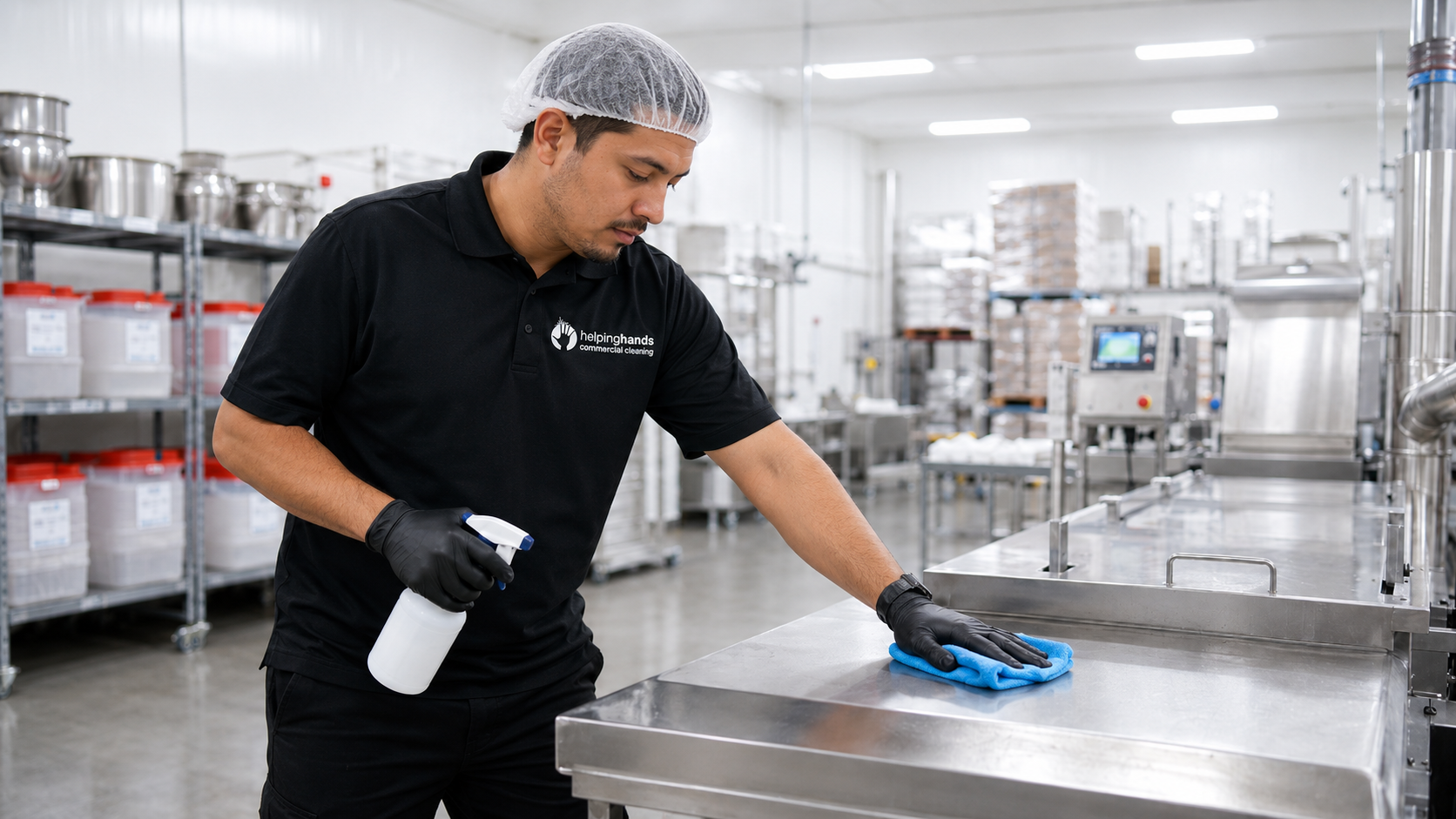
Why Food-Adjacent Manufacturing Facilities in Elk Grove Village Require a Different Level of Industrial Cleaning
What cleaning standards do food-adjacent manufacturing facilities in Elk Grove Village, Illinois actually require? Food-adjacent manufacturing facilities in Elk Grove Village require industrial cleaning programs that go beyond standard janitorial scope, combining the contamination-control protocols of food-safe environments with the scale and shift-structure demands of active manufacturing operations. These facilities must maintain separation between production zones, prevent cross-contamination from packaging, raw materials, and finished product areas, and demonstrate compliance with FDA, OSHA, and internal corporate audit standards through documented inspection records.
Keep Your Facility Clean, Safe, and Inspection-Ready
Get professional cleaning services tailored to your building.
Key Takeaways
- Food-adjacent manufacturing facilities in Elk Grove Village need industrial cleaning programs that combine food-safe contamination control with the scale and shift demands of active manufacturing, going well beyond standard janitorial scope.
- Zone-specific cleaning protocols, with approved cleaning agents and documented verification steps, are required to prevent cross-contamination between production, raw material, packaging, and finished product areas.
- Cleaning programs must satisfy overlapping OSHA housekeeping standards and FDA sanitation requirements, backed by documented inspection records that hold up under audit.
- Direct-hire cleaning crews are essential in these facilities because their facility-specific training and background checks are documented and accountable, unlike crews that rotate between assignments.
- High dusting and overhead cleaning must be scheduled around production timing so dust and debris don’t migrate into open product, packaging, or food contact surfaces.
- A compliant program starts with an on-site walkthrough that maps zones and cleaning sequences, then covers scheduled floor care, high dusting, restroom and breakroom service, loading dock cleaning, and weekly supervisor inspections with photo documentation.
What Food-Adjacent Manufacturing Means and Why It Changes Everything
Food-adjacent manufacturing covers a broad range of operations: facilities that produce, package, process, or handle food products or ingredients, as well as facilities that manufacture packaging materials, equipment, or components that come into contact with food at any point in the supply chain. In Elk Grove Village, one of the most concentrated industrial corridors in North America, food-adjacent manufacturers operate alongside standard industrial facilities, logistics operations, and distribution centers.
The distinction matters because the cleaning standards that apply to a food-adjacent manufacturing environment are fundamentally different from those that govern a standard warehouse or assembly plant. Contamination in a food-adjacent facility is not an aesthetic problem. It is a product safety problem, a regulatory problem, and in serious cases a public health problem. The janitorial program in these facilities is not support infrastructure. It is part of the production compliance system.
The Contamination Control Requirements That Standard Industrial Cleaning Cannot Meet
Standard industrial cleaning programs are built to address floor maintenance, restroom and breakroom sanitation, loading dock cleaning, and high dusting of overhead structures. These are necessary components of any industrial janitorial program. In a food-adjacent manufacturing facility, they are the starting point, not the complete scope.
Food-adjacent facilities require zone-specific cleaning protocols that prevent cross-contamination between production areas, raw material storage, packaging zones, and finished product areas. Each zone has a defined cleaning sequence, a defined set of approved cleaning agents, and a documented verification step that confirms the zone was cleaned correctly before the next production run begins.
Surface material matters in ways that do not apply to standard industrial cleaning. Equipment housings, conveyor systems, and production surfaces in food-adjacent environments require cleaning agents that are approved for use in proximity to food contact surfaces. The wrong product applied to the wrong surface in a food-adjacent facility creates a compliance violation, not just a cleaning error.
Pest prevention is an active component of food-adjacent facility maintenance that intersects directly with the janitorial program. Cleaning schedules that leave debris, residue, or standing moisture in production or storage zones create conditions that attract pests and trigger regulatory citations. A janitorial program in a food-adjacent facility has to be designed with pest prevention in mind, not treated as a separate issue.
OSHA and FDA Compliance in Food-Adjacent Manufacturing Environments
Food-adjacent manufacturing facilities in Elk Grove Village operate under overlapping compliance frameworks. OSHA housekeeping standards govern walking-working surfaces, aisle clearance, and hazard communication for cleaning chemicals used on-site. FDA requirements, and in some cases FSMA regulations, govern the sanitation standards that apply to food contact surfaces, production environments, and storage areas.
A janitorial program in a food-adjacent facility has to be built with both frameworks in mind. Cleaning chemicals require Safety Data Sheet documentation and must be stored and used in compliance with OSHA hazard communication standards. Cleaning sequences in production areas must align with FDA sanitation requirements for the specific products being manufactured or handled.
Documented inspection records are not optional in this environment. When an FDA auditor or a corporate food safety team conducts a facility review, the cleaning program documentation is part of the audit. A janitorial vendor that cannot produce inspection records, approved product lists, and cleaning sequence documentation on request is a liability for the facility, not a service provider.
Why Direct-Hire Crews Are a Compliance Requirement in Food-Adjacent Facilities
Food-adjacent manufacturing facilities in Elk Grove Village cannot accept the accountability gaps that come with subcontractor-based cleaning models. Facilities operating under FDA oversight and corporate food safety audit programs require cleaning crews whose training is documented, whose backgrounds have been verified, and whose presence in the facility is accountable to a named local contact.
Subcontractor cleaning crews rotate. When a crew changes, the new personnel may not have received training on the zone-specific protocols, approved cleaning agents, or contamination-control sequences that the facility requires. In a standard commercial office, a crew change is an inconvenience. In a food-adjacent manufacturing facility, a crew change that introduces undertrained personnel into a production zone is a compliance event.
Direct-hire cleaning employees are trained on the specific requirements of each facility they service before their first visit. That training is documented. Their background checks are on file. When a corporate auditor or an FDA inspector asks who cleaned the production area and what training they received, a direct-hire cleaning program has answers. A subcontractor chain does not.
High Dusting and Overhead Cleaning in Food-Adjacent Environments
Overhead dust accumulation is a contamination risk in any manufacturing facility. In a food-adjacent environment, it is a product safety risk. Dust, particulate, and debris that accumulates on rafters, beams, ductwork, and the tops of racking systems above production or packaging zones can migrate into open product, packaging materials, or food contact surfaces below.
High dusting programs in food-adjacent facilities require scheduling that takes production timing into account. Overhead cleaning above active production zones has to occur when those zones are offline or adequately protected. The cleaning sequence, the equipment used, and the verification step after cleaning are all components of a compliant high dusting program in this environment.
Facilities that treat overhead cleaning as an occasional add-on rather than a scheduled component of the janitorial program are accumulating contamination risk on a continuous basis.
What a Compliant Cleaning Program Looks Like for Food-Adjacent Manufacturers in Elk Grove Village
A properly scoped janitorial program for a food-adjacent manufacturing facility in Elk Grove Village begins with an on-site walkthrough that maps production zones, identifies food contact surface areas, documents approved cleaning agents for each zone, and establishes the cleaning sequence and verification steps required for compliance.
From that walkthrough comes a program that covers zone-specific cleaning protocols for production, packaging, raw material storage, and finished product areas, floor scrubbing and maintenance calibrated to the soil load and surface material of each zone, high dusting on a documented rotation above all production and storage areas, restroom and breakroom service scaled to workforce size and shift count, loading dock cleaning covering outdoor debris, vehicle residue, and packaging waste, and weekly supervisor inspections with photo documentation delivered to facility management.
The program is built around the production calendar and the compliance requirements of the facility, not the scheduling preferences of the cleaning vendor.
Helping Hands Commercial Cleaning: Industrial Programs Across Elk Grove Village Since 2001
Helping Hands Commercial Cleaning is a woman-owned commercial janitorial company headquartered in Elmhurst, Illinois, serving DuPage, Cook, Kane, Will, and Lake Counties since 2001. The company employs direct-hire employees exclusively, holds GBAC certification for infection-control protocols, and conducts weekly supervisor inspections with photo documentation on every account.
For food-adjacent manufacturing facilities in Elk Grove Village and the broader Cook County industrial corridor, Helping Hands offers on-site walkthroughs to assess the specific cleaning scope, compliance requirements, and production schedule of each facility before building a program.
To schedule a walkthrough, contact Helping Hands Commercial Cleaning at Call (630) 530-8121.